· 11 min
Oct 29: The count moved against Netanyahu. The market moved against Eisenkot. And two rate calls we got right
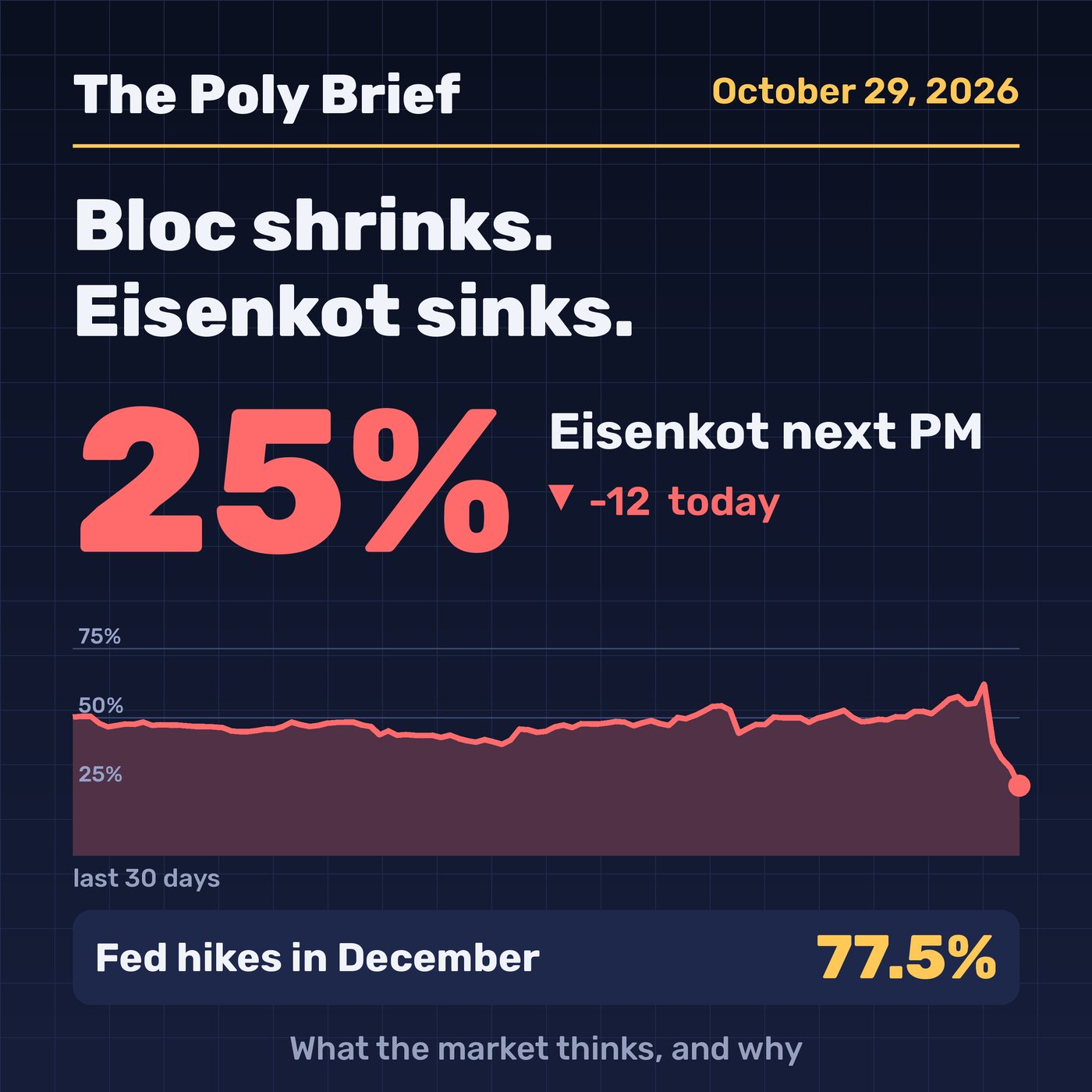
With almost 90% of the votes counted, Netanyahu's bloc fell from 57 seats to 53, and the Arab parties hit a record 19. And yet the market moved the other way: Gadi Eisenkot dropped from 36.7% to 25% to be Israel's next prime minister, while Netanyahu holds at 45.5%. Why: the only route to 61 for Eisenkot runs through the Arab parties, and his own partners have said no. Plus one trade of about $130,000 against him, the scenarios analysts see (an Arab-backed government, a unity government, or another election), and the dates from here.
Then Who called it: the Bank of Canada hiked to 2.5%, its first hike since 2023 (we said 84.3%), and the Fed held, 10 to 2, with both dissenters wanting a hike (we said 95.8%). Now the market gives a Fed hike in December 77.5%. Why, what could stop it, and the data between now and December 9.
Listen to this episode
- Listen onApple Podcasts
- Listen onSpotify
- YouTubesoon
Markets in this episode
Odds at snapshot:
Prime Minister of Israel after the next election?
▼ −2 today+19 7 days
▼ −13 today−25 7 days
24h volume: $5.3M
Israel Election: Likud # of seats?
▲ +4 today+76 7 days
▼ −4 today−6 7 days
24h volume: $1.8M
Fed Decision in December?
▲ +1 today−1 7 days
▲ +1 today+2 7 days
24h volume: $2.0M
Transcript
Read the full transcript
Cold open
Maya: Yesterday, the vote count moved against Netanyahu. His bloc went from fifty seven seats down to fifty three.
Daniel: And the market moved against Gadi Eisenkot. Down twelve points. Somebody in there is doing different math.
Maya: This is The Poly Brief. It's Thursday, October twenty ninth. I'm Maya.
Daniel: And I'm Daniel. Every day we take the biggest moves on Polymarket, show you where the odds stand, and ask: why is the market betting this way?
Maya: Today: Israel's count is almost done, and the numbers and the prices are telling two different stories. Then, Who called it, for two central banks. And what the market expects from the Fed in December. Let's go.
Story 1: Israel, the math after the count
Maya: Story one. The board. Next prime minister of Israel: Benjamin Netanyahu, forty five and a half percent. About where he was yesterday morning.
Maya: Gadi Eisenkot: twenty five. Yesterday morning, thirty six point seven. On Tuesday afternoon, while people were still voting, about sixty five.
Daniel: Naftali Bennett, four. Avigdor Lieberman, two and a half. Almost seventy nine million dollars have traded on this market. More than five million in the last day.
Daniel: And on how many seats the Likud party gets, twenty five to twenty nine is at ninety eight percent.
Maya: So, the count.
Daniel: As of last night, almost ninety percent of the votes are counted, according to the Times of Israel. The Likud party has twenty six seats. Eisenkot's party, twenty one.
Daniel: Netanyahu's bloc: fifty three. Yesterday morning, with about forty percent counted, it was fifty seven. Eisenkot's bloc: forty eight.
Daniel: And the Arab parties: nineteen seats. A record. The previous high was fifteen. Ra'am alone went from four seats at dawn to seven.
Maya: So Netanyahu lost four seats during the day, and Eisenkot is the one who fell twelve points. Explain.
Daniel: Reason one: the arithmetic. Eisenkot's bloc, forty eight, plus the Arab parties, nineteen. That's sixty seven. A majority. It's the only route to sixty one that runs through Eisenkot.
Daniel: Reason two: his own partners. Bennett and Lieberman both promised during the campaign not to sit with the Arab parties this time. Lieberman has also rejected a minority government that relies on their support from outside.
Daniel: And according to Channel Twelve, as reported by the Times of Israel, Lieberman has mostly stopped talking to the other leaders of his bloc. He isn't answering calls from Eisenkot or from Bennett.
Maya: So the majority exists. It just can't get anyone on the phone.
Daniel: Reason three: the analysts. A Times of Israel analysis yesterday afternoon said another election might be the most likely outcome. And in that case Netanyahu stays on as caretaker.
Daniel: Which, remember, this market doesn't count. It pays only for a prime minister who is sworn in.
Maya: And the drop itself? When did it happen?
Daniel: Mostly in one hour. Eisenkot was at about thirty one percent at six in the evening, Israel time. A minute after six, one account bought about a hundred and thirty thousand dollars against him. In one trade.
Daniel: By seven he was at twenty six, and he has stayed there since. No single headline at that minute explains it. The analysis pieces about the Arab parties came out in the two hours before. The timing matches. That is not proof.
Maya: A hundred and thirty thousand dollars. That's a lot of confidence in Lieberman not picking up the phone.
Maya: The other side. What could still turn this?
Daniel: First, promises in Israeli politics have a shelf life. Bennett and Lieberman both sat in the government with Ra'am in twenty twenty one. And a source in Eisenkot's bloc told Walla: whoever needs to break promises, let him break them.
Daniel: Second, nobody wants another election. President Herzog said yesterday that after this vote, everything must be done to avoid one. Eisenkot says that after such high turnout, another election would be a mistake.
Daniel: Third, a unity government. Yohanan Plesner of the Israel Democracy Institute says serious unity talks are perhaps more likely. That could still mean Netanyahu. Or it could mean someone else, if a deal comes with conditions.
Maya: And Netanyahu is at forty five, not eighty, for a reason. His bloc is eight seats short, and the double envelopes are not expected to fix that.
Daniel: Right. Between four hundred thirty and four hundred eighty thousand double envelopes are being counted today. Soldiers, mostly. Analysts expect one or two seats to move, at most. Not the balance between the blocs.
Maya: What to watch. The double envelopes, today, maybe into Friday. Official results on November fourth. Herzog's consultations after that, and according to Ynet he might start reaching out to leaders as early as Friday.
Daniel: The new Knesset is sworn in around November tenth. Then the first candidate gets twenty eight days, plus fourteen more. We'll come back for the first mandate around November twelfth.
Maya: Bottom line: the count shrank Netanyahu's bloc, but the market isn't betting on seats. It's betting on who will sit with whom. And right now, nobody wants to sit with the only majority on the table.
Daniel: If you want this explained without counting to sixty one at home, hit follow. We count so you don't have to.
Bridge
Maya: Daniel, you took the stairs again? You're out of breath.
Daniel: The elevator in my building. Out of order. Day three.
Maya: Didn't the building manager say Monday?
Daniel: He said Monday. Then he said Wednesday. This morning there's a new sign. It just says: soon.
Maya: Soon. That's not a forecast, that's a mood.
Daniel: I'd love one person who says a date and then actually does the thing.
Maya: Well, good news. Yesterday two of them did. And we called both.
Story 2: Who called it, and the Fed in December
Maya: Story two. Who called it? The Bank of Canada. On October twentieth the market gave a hike seventy three and a half percent. Yesterday morning, eighty four point three.
Daniel: And the Bank of Canada raised its rate by a quarter point, to two and a half percent. Its first hike since July twenty twenty three.
Maya: The Fed. Yesterday morning, no change was at ninety five point eight.
Daniel: And the Fed held, at three and three quarters to four percent. But the vote was ten to two. Lisa Cook and Beth Hammack, the president of the Cleveland Fed, both voted for a hike.
Maya: So the verdict: the market called both. After three elections in a row, it's nice to say that out loud.
Daniel: Central banks publish a calendar. Voters don't.
Maya: Okay. The new board. Fed decision in December. A quarter point hike: seventy seven and a half percent. No change: twenty.
Daniel: About seven million dollars traded on this one, two million in the last day. And the hike was at seventy seven a month ago. It barely moved.
Daniel: Futures are a little more sure. After the meeting, CME FedWatch had a December hike at about eighty one percent. Bloomberg's data put it around eighty five.
Maya: So why does the market think the Fed hikes in December?
Daniel: Reason one: the dissents. Both people who disagreed yesterday wanted a hike. Nobody dissented the other way. And the statement upgraded the economy. Back in September, the word was solid. Now it's strong.
Daniel: Reason two: inflation. US inflation was three point seven percent in September. Gasoline alone was up thirty four percent from a year ago, according to the Bureau of Labor Statistics. And oil settled above a hundred and two dollars a barrel yesterday.
Daniel: Reason three: Kevin Warsh, the chair. He said he doesn't believe in forward guidance, absent a crisis. But also: we've made clear our readiness to act, and we have shown our willingness to act.
Daniel: Brett Ryan at Deutsche Bank put it this way, according to Bloomberg. He was saying that they're going to tighten further, without saying it.
Maya: We don't do forward guidance. But here is some guidance. Facing forward.
Daniel: And reason four: the neighbor already moved. The Bank of Canada said there could be a need to raise rates further. Markets give Canada about a forty five percent chance of another hike in December.
Maya: The other side. What stops a December hike?
Daniel: First, take out food and energy, and US inflation was two point six percent in September. Most of this is oil.
Daniel: Second, jobs. The US added only twenty nine thousand jobs in September, and unemployment is four point two percent. Warsh himself said the monetary medicine is starting to work.
Daniel: Third, the calendar is awkward. The Fed decides on December ninth. The November inflation report comes out on December tenth. A day late.
Maya: So they'll find out how hot it was the morning after they decide.
Daniel: And Samuel Tombs at Pantheon thinks inflation peaks soon, and that the hikes markets are pricing are overdone.
Maya: What to watch. Today, the Fed's favorite inflation gauge for September, and the first estimate of third quarter growth. Then the October jobs report on November sixth, and inflation on November tenth.
Daniel: And December ninth is a double header. The Fed and the Bank of Canada decide on the same day. We'll be there the morning after.
Maya: Bottom line: the Fed didn't hike, but two of its members already want to, and Warsh left the door open without calling it a door. Seventy seven and a half percent still leaves more than one chance in five that December is a hold.
Close
Maya: That's The Poly Brief for today. Every article and number is linked in the description.
Daniel: And a reminder: these odds are prices, not prophecies. Nothing here is investment advice. Forty five percent for Netanyahu means more than half the time, somebody else ends up sworn in, or nobody does.
Maya: If you liked it, follow or subscribe, leave us a rating, and send it to the friend who still thinks the count is the end of an Israeli election.
Daniel: We're here every morning. See you tomorrow!
Sources
- Polymarket: Prime Minister of Israel after the next election? (2026-10-29)
- Polymarket: Israel Election: Likud # of seats? (2026-10-29)
- Times of Israel: With 90% of votes counted, Netanyahu bloc has 53 seats, Eisenkot's 48; Arab parties surge to 19 (2026-10-28)
- Ynetnews: Netanyahu bloc slips to 55 seats with nearly half the vote counted (2026-10-28)
- Ynetnews: Netanyahu bloc at 53 seats, Eisenkot bloc at 48 as nearly all votes counted (2026-10-28)
- Times of Israel: Arab parties emerge as potential kingmakers, presenting Zionist opposition with fateful choice (2026-10-28)
- Times of Israel: Change bloc alliance with Arabs, unity government, or new election: 3 scenarios for what comes next (2026-10-28)
- Times of Israel: Netanyahu vows to stick with far-right partners as Eisenkot seeks path to 'bring change' (2026-10-29)
- Times of Israel: Herzog urges avoiding another election, calls for 'open mind' in coalition talks (2026-10-28)
- Times of Israel: Last-to-be-counted 'double envelope' votes could shift Knesset seats, but not balance of power (2026-10-28)
- Times of Israel: How will a new coalition be formed and what powers does the caretaker government have? (2026-10-28)
- Jerusalem Post: Anti-Netanyahu bloc vows not to let chance to replace government slip away (2026-10-28)
- Polymarket Data API: Trades on "Gadi Eizenkot" (PM market), Oct 28 13:00-18:00 UTC (2026-10-29)
- Polymarket: Fed Decision in December? (2026-10-29)
- Polymarket: Bank of Canada Decision in October? (2026-10-28)
- Polymarket: Fed Decision in October? (2026-10-28)
- Bank of Canada: Bank of Canada increases policy rate to 2.5% (2026-10-28)
- BNN Bloomberg: Bank of Canada interest rate hike: First BoC increase since July 2023 (2026-10-28)
- Kitco (Reuters): Canadian 2-year yield hits two-year high as BoC hikes interest rates (2026-10-28)
- Federal Reserve: Federal Reserve issues FOMC statement (2026-10-28)
- Yahoo Finance: Rate decision live: rates held steady in split vote, Warsh says politics played 'no role' (2026-10-28)
- Fattail.ai: Warsh Press Conference: December, Dissents and the VIX (2026-10-28)
- Admiral Markets: Warsh press conference, October 2026 (2026-10-28)
- Briefs (citing Bloomberg): Warsh Keeps December Rate Hike in Play (2026-10-28)
- Financial News: U.S. Fed holds rates steady; odds of a December hike at 81% (2026-10-29)
- Mitrade: Fed holds, two dissent, December 85% priced (2026-10-29)
- US Bureau of Labor Statistics: Consumer Price Index, September 2026 (2026-10-14)
- US Bureau of Labor Statistics: The Employment Situation, September 2026 (2026-10-02)
- Yahoo Finance: Fed October meeting starts today (2026-10-27)
- Federal Reserve: Meeting calendars and information (2026-10-29)