· 11 min
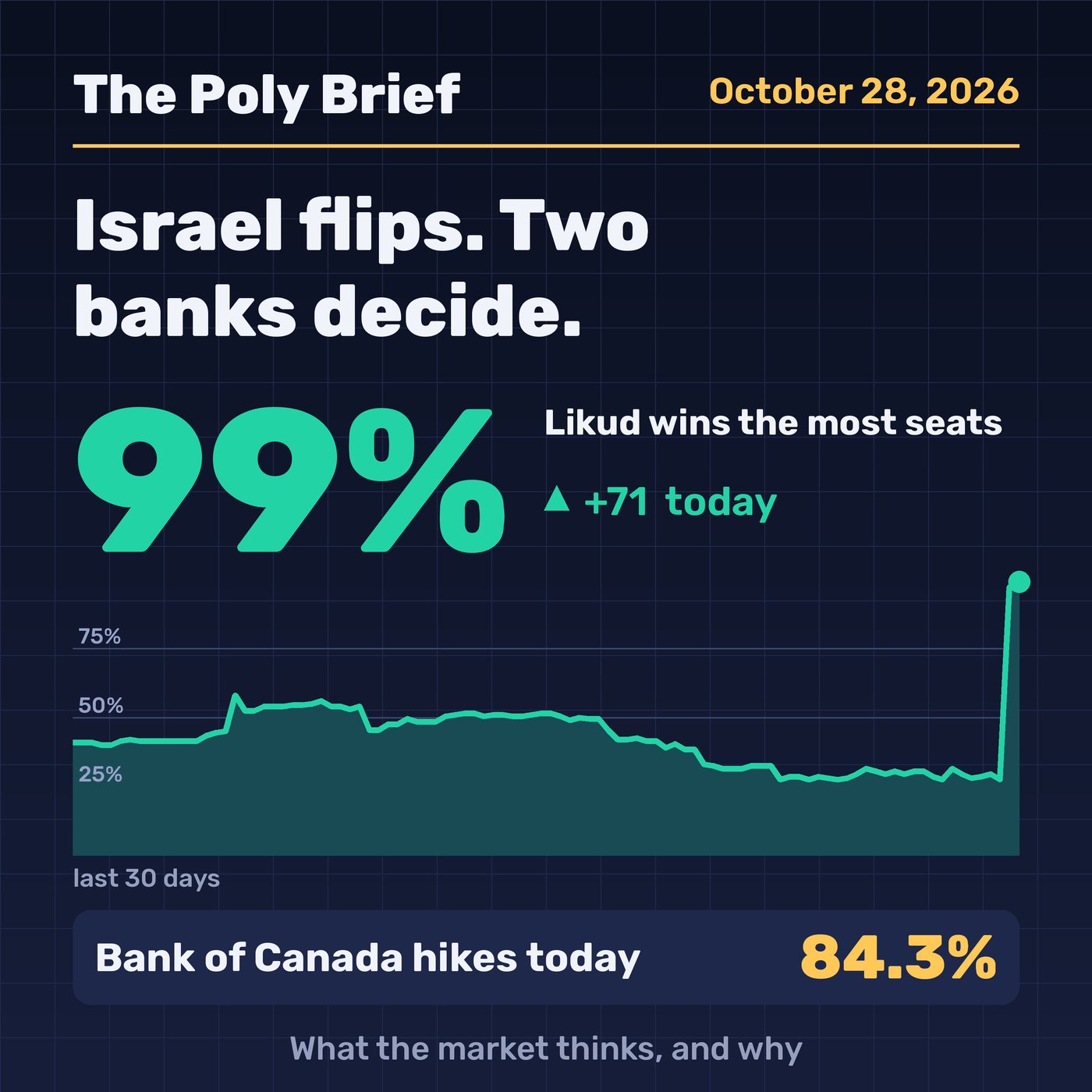
Oct 28: Israel flips overnight, Likud from 28.5% to 99%. And two central banks decide today
Yesterday morning the market gave Gadi Eisenkot's party 71.5% to finish first in Israel's election. This morning Likud is at 99.2%. All three exit polls put Likud on top, and with about 37% of the votes counted, Likud has 28 seats to Eisenkot's 21, and Netanyahu's bloc is at 57. Who called it: the market didn't, and neither did the polls. Netanyahu is now at 46.5% to be the next prime minister, up 20 points, but no bloc is at 61, and the market gives "no majority" 96.7%. Why the price is that low, what the double envelopes could change, and the timeline from here.
Then central bank Wednesday. The Bank of Canada decides this morning, and the market gives a hike 84.3%, even though economists are split 19 to 15. The Fed decides this afternoon, and "no change" is at 95.8%, six days before the midterms. Why the two neighbors are on different clocks, and what could surprise.
Listen to this episode
- Listen onApple Podcasts
- Listen onSpotify
- YouTubesoon
Markets in this episode
Odds at snapshot:
Israeli Legislative Election Winner
▲ +71 today+72 7 days
▼ −71 today−71 7 days
24h volume: $9.3M
Prime Minister of Israel after the next election?
▲ +20 today+19 7 days
▼ −20 today−14 7 days
24h volume: $15.4M
Israel Election: Which Bloc Wins More Seats?
▲ +52 today+49 7 days
▼ −52 today−49 7 days
24h volume: $149K
Fed Decision in October?
▲ +2 today+8 7 days
▼ −2 today−9 7 days
24h volume: $9.2M
Bank of Canada Decision in October?
▲ +2 today+13 7 days
▼ −2 today−13 7 days
24h volume: $56K
Transcript
Read the full transcript
Cold open
Maya: Yesterday morning, the market gave Eisenkot's party seventy one and a half percent to finish first in Israel's election.
Daniel: This morning, Likud is at ninety nine. Overnight. One exit poll did all of that.
Maya: This is The Poly Brief. It's Wednesday, October twenty eighth. I'm Maya.
Daniel: And I'm Daniel. Every day we take the biggest moves on Polymarket, show you where the odds stand, and ask: why is the market betting this way?
Maya: Today: Who called it in Israel, and the honest answer is not the market. Then two central banks decide on the same day, and the market thinks they go in different directions. Let's go.
Story 1: Israel, the morning after
Maya: Story one. Who called it? On Monday, the market gave Eisenkot's party seventy percent to be the largest party. Yesterday morning, seventy one and a half. Likud, twenty eight and a half.
Daniel: And the bloc market. On Monday the opposition was at fifty six and a half to win more seats than Netanyahu's bloc. This morning, Netanyahu's bloc is at ninety eight and a half.
Maya: So the verdict. The market was wrong. Twice. And so were the polls.
Daniel: And that's three favorites in three days. Brazil on Sunday, Serbia on Sunday, Israel on Tuesday. At this point we should open a support group.
Maya: Okay. The board, as of this morning. Largest party: Likud, ninety nine point two. Next prime minister: Benjamin Netanyahu, forty six and a half, up twenty points in a day. Gadi Eisenkot, thirty six point seven, down twenty.
Daniel: About seventy three million dollars have traded on the prime minister market. In the last day alone, about fifteen million. Eisenkot was at about sixty five percent yesterday afternoon.
Maya: What happened?
Daniel: Ten at night, Israel time, the polls close. The final polls on Friday had Eisenkot's party first, at twenty two or twenty three seats, and Likud at nineteen to twenty one.
Daniel: Then the exit polls. All three channels had Likud first. Kan and Channel Thirteen at twenty five, Channel Twelve at twenty four. Eisenkot's party at twenty one to twenty three.
Maya: And the market?
Daniel: Likud was at thirty two percent before the exit polls. An hour later, eighty two. By two in the morning, ninety seven.
Daniel: And the updates overnight kept moving one way. At two in the morning, Channel Twelve's updated exit poll had Likud at twenty seven, and Netanyahu's bloc ahead, fifty two to forty nine.
Maya: And the actual count?
Daniel: At about six this morning, with thirty seven percent of the votes counted, according to Ynet: Likud, twenty eight seats. Eisenkot's party, twenty one. In votes, about twenty two percent against sixteen.
Daniel: Turnout was seventy seven point seven percent, the highest since nineteen ninety nine.
Maya: So if Likud is so far ahead, why is Netanyahu only at forty six?
Daniel: Because the magic number is sixty one, and nobody has it. On that same count, Netanyahu's bloc has fifty seven seats. Eisenkot's bloc, forty six or forty seven. The Arab parties, sixteen or seventeen.
Daniel: And there's a market for exactly that. Does any coalition reach a majority? No, at ninety six point seven.
Maya: And there was a little drama at dawn, right?
Daniel: Right. At four in the morning, with a quarter of the votes counted, Ra'am, one of the Arab parties, was just under the threshold. Without it, Netanyahu's bloc was at sixty three. A majority.
Daniel: About an hour later, Ra'am crossed the threshold with four seats, and the bloc fell to fifty nine, then fifty seven. Netanyahu's price peaked at about fifty two, and an hour later it was back at forty six. No outlet ties the two together, but the timing matches.
Maya: Threshold math at five in the morning. That's democracy and a spreadsheet at the same time.
Daniel: And the speeches. Netanyahu, at three in the morning: Likud is the largest party, and we are still waiting for the true results. Eisenkot, a little after one in the morning: the public decided in favor of change.
Daniel: Naftali Bennett: a great deal can still change. And Avigdor Lieberman: on Friday we'll know much better.
Maya: The other side. What could still turn this around?
Daniel: First, the double envelopes. Soldiers, evacuees, people voting away from home. More than six hundred fifty thousand of them, counted on Thursday, maybe Friday morning. That's enough to push a small party over the threshold, or under it.
Daniel: Second, Netanyahu still needs about four more seats, and the people who could give them to him spent the campaign saying no. Eisenkot says he won't serve under Netanyahu, not even in a rotation.
Daniel: And third, the other math. The opposition plus the Arab parties would be around sixty eight, according to the Times of Israel. But Bennett has ruled out relying on them, and Netanyahu calls that forbidden. So on paper there's a majority that nobody wants to use.
Maya: And the rule we keep repeating: this market pays only for a prime minister who is sworn in. If nobody forms a government, Israel goes to another election, and Netanyahu stays on as caretaker. That doesn't count.
Maya: What to watch. The double envelopes, Thursday or Friday. Official results by November fourth. The new Knesset is sworn in on November tenth.
Daniel: Then the President's consultations, within a week of the official results. The market for the first mandate already has Netanyahu at sixty seven and a half. We'll come back to that one around November twelfth.
Maya: Bottom line: on election night the market moved in an hour, and it moved the right way. The problem is that for three weeks before that, it trusted the polls. And the polls had the wrong party in first place.
Daniel: If you want to know how this ends without reading the threshold math at five in the morning, hit follow. We'll do it for you.
Bridge
Maya: Daniel, why is your jacket wet? It stopped raining an hour ago.
Daniel: My umbrella flipped inside out at the bus stop. Brand new. Two days old.
Maya: Did you keep the receipt?
Daniel: I kept the umbrella. What's left of it. It's in my bag, looking at me.
Maya: You should have checked the wind, not just the rain.
Daniel: That's what I get for trusting one forecast.
Maya: Well, two central banks are about to tell us which forecast they trust. And one of them might just open the umbrella.
Story 2: Central bank Wednesday
Maya: Story two. The board. The Bank of Canada decides this morning. A quarter point hike: eighty four point three percent. Up thirteen points in a week.
Daniel: When we covered this on October twentieth, the hike was at seventy three and a half. The morning before that, fifteen. It's a small market, about half a million dollars, but it has moved a lot.
Maya: And the Fed decides this afternoon?
Daniel: Right. No change: ninety five point eight percent. A hike, under four. On October fifteenth, after a hot inflation report, the hike was at thirty one and a half.
Maya: So, Canada first. Why does the market think Canada hikes?
Daniel: Reason one: inflation. Canada's inflation was three point one percent in September. Gasoline alone was up almost twenty eight percent from a year ago. The Bank of Canada's rate is two and a quarter, and it has held for seven decisions in a row.
Daniel: Reason two: Tiff Macklem, the governor. On October seventeenth he asked, out loud, whether inflation comes back down on its own, or whether the bank will have to raise interest rates. And he said that if oil stays around a hundred dollars, inflation should gradually drift up.
Daniel: Reason three: expectations. Companies that answer the bank's own survey expect three point seven percent inflation over the next year. Central bankers hate that number more than inflation itself.
Maya: And economists agree with the market?
Daniel: Barely. In a Reuters poll last week, nineteen of thirty four economists expected a hike. In the poll before that, most of them expected a hold for the rest of the year. Even RBC, which calls a hike, says it has very low conviction.
Maya: So the forecasters have very low conviction, and the market has eighty four percent. Somebody here is more confident than the people who wrote the forecast.
Maya: The other side, for Canada?
Daniel: Take out gasoline, and inflation is two point two percent. The core measures the bank watches are at one point eight and one point nine. Below target.
Daniel: And the economy is weak. Canada lost about sixty eight thousand jobs in September. Unemployment is six and a half percent. TD Securities still expects a hold today, and calls it a close call.
Maya: Now the Fed. Why so sure of a hold?
Daniel: First, the Fed already hiked. In September it raised rates by a quarter point, and the vote was unanimous. Canada hasn't started. So this isn't really two neighbors disagreeing. It's one neighbor catching up.
Daniel: Second, Kevin Warsh, the chair, before the quiet period: I don't prejudge meetings. And: we removed a dose of accommodation about a month ago. The market heard: not this time.
Daniel: Third, the calendar. The midterms are on November third, six days from now. According to 24/7 Wall Street, the Fed has hiked within a week of an election only once since nineteen ninety. That was in twenty twenty two.
Maya: And what could surprise?
Daniel: Bank of America's economist, Aditya Bhave, told Kiplinger: the inflation picture has gotten worse on net since the September meeting. US inflation was three point seven percent in September. And in April, three regional Fed presidents dissented in the hawkish direction. All three vote this year.
Daniel: So the surprise isn't a hike. It's a hold with dissents, and a loud hint about December. Futures already give December a hike at about seventy three percent, according to Kiplinger.
Maya: What to watch. The Bank of Canada at nine forty five in the morning in Ottawa, with a new forecast. The Fed at two in the afternoon Eastern, and Warsh's press conference after that.
Maya: Bottom line: the market thinks Canada flinches first and the Fed waits for December. Eighty four percent still leaves about one chance in six that Ottawa holds. We'll see who called it tomorrow.
Close
Maya: That's The Poly Brief for today. Every article and number is linked in the description.
Daniel: And a reminder: these odds are prices, not prophecies. Nothing here is investment advice. Yesterday's seventy one and a half percent is the best example we've had: almost three times in ten, it doesn't happen. Last night it didn't.
Maya: If you liked it, follow or subscribe, leave us a rating, and send it to the friend who stayed up for the count.
Daniel: We're here every morning. Tomorrow, two rate decisions and one verdict. See you then!
Sources
- Polymarket: Israeli Legislative Election Winner (2026-10-28)
- Polymarket: Prime Minister of Israel after the next election? (2026-10-28)
- Polymarket: Israel Election: Which Bloc Wins More Seats? (2026-10-28)
- Polymarket: Israel Election: Any Coalition Wins a Majority? (2026-10-28)
- Polymarket: Who will receive the first mandate to form Israel's next government? (2026-10-28)
- Ynetnews: Final Israel election polls put Eisenkot's Yashar ahead of Likud (2026-10-23)
- Israel Hayom: Israel election 2026 exit polls: Full results (2026-10-27)
- Times of Israel: In reversal, pro-Netanyahu bloc rises to 52 seats in Channel 12 updated exit poll (2026-10-28)
- Times of Israel: Pro-Netanyahu bloc holds big lead with just over a quarter of ballots counted (2026-10-28)
- Ynet: 37% of votes counted: Netanyahu bloc at 57 seats (Hebrew) (2026-10-28)
- Ynet: Partial results at 31% counted (Hebrew) (2026-10-28)
- Ynet: Partial results at 28% counted (Hebrew) (2026-10-28)
- Globes: Election night live: count and speeches (Hebrew) (2026-10-28)
- Walla: Real results: over 2 million votes counted, Netanyahu ahead (Hebrew) (2026-10-28)
- Mako (N12): Election 2026 live blog (Hebrew) (2026-10-28)
- Ynetnews: Bennett: "Netanyahu has lost" (2026-10-28)
- Ynet: Lieberman on election night (Hebrew) (2026-10-27)
- Times of Israel: Exit polls show Israeli rejection of current Netanyahu coalition, but uncertainty on its replacement (2026-10-28)
- Ynetnews: What happens after the polls close: the count, double envelopes and the timeline (2026-10-27)
- Jerusalem Post: Israel election 2026: exit polls, turnout and threshold (2026-10-27)
- Times of Israel: 2026 Israeli elections: what you need to know (2026-10-24)
- Polymarket: Bank of Canada Decision in October? (2026-10-28)
- Polymarket: Fed Decision in October? (2026-10-28)
- MoneySense: Bank of Canada interest rate forecast: What to expect on October 28 (2026-10-22)
- The Hub: Macklem signals higher inflation forecast as oil shock tests Bank of Canada's hold (2026-10-19)
- Scotiabank Economics: Daily Points, October 19 (2026-10-19)
- Kitco (Reuters): Bank of Canada to raise rates to 2.50% on October 28 and once again by end-March: Reuters poll (2026-10-23)
- investingLive: Canada September CPI 3.1% y/y vs 3.2% expected (2026-10-19)
- RBC Economics: The Bank of Canada at an inflection point: Inflation fears live on (2026-10-22)
- Canadian Mortgage Professional: Could inflation fears push the Bank of Canada toward its first hike since 2023? (2026-10-22)
- Canadian Mortgage Professional: Inflation return to 2% thrown into doubt, Bank of Canada survey shows (2026-10-20)
- Mitrade (FXStreet): Canadian Dollar extends winning streak as Fed-BoC policy divergence comes into focus (2026-10-23)
- Federal Reserve: FOMC statement, September 16, 2026 (2026-09-16)
- China Daily HK (Bloomberg): Fed chair Warsh boosts market expectations of rate hold in October (2026-10-16)
- investingLive: US September CPI 3.7% vs 3.6% expected (2026-10-14)
- 24/7 Wall St: Traders Give Warsh A 42% Chance Of Doing Something This Month That Has Only Happened Once In The Past 36 Years (2026-10-15)
- Kiplinger: October 2026 Fed Meeting: Live Updates and Commentary (2026-10-27)
- Continuum Economics: FOMC keeps rates on hold but three of four dissents are hawkish (2026-04-29)