· 11 min
Oct 27: Israel votes with Eisenkot at 57%, moved by one trader at dawn. And Anthropic files to go public
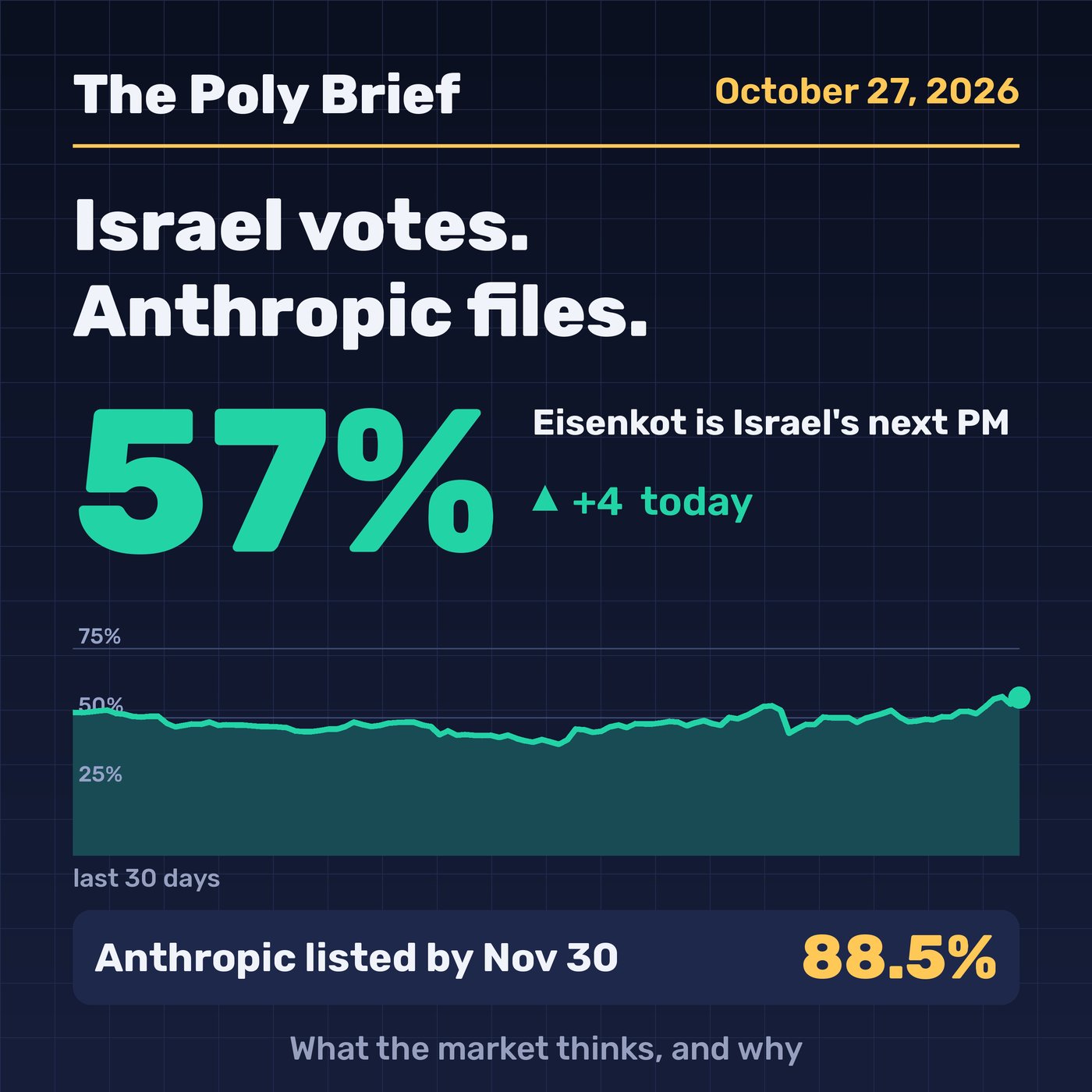
Israel votes today, and the market gives Gadi Eisenkot 57% to be the next prime minister, up four points overnight. Netanyahu is at 26.5%, and Naftali Bennett fell from 12.5% to 5.5%. We looked at the actual trades: the dawn jump for Eisenkot was one account spending about $4,900 in five minutes, and Bennett's slide started with a single $15,000 bet. No news explains either. What that says about a $57 million market, the rule that makes a caretaker Netanyahu a non-event, and what to watch tonight. Market figures are not a survey based on recognized statistical methods, and the polls quoted are from Friday and outdated.
Then Anthropic, which filed publicly for its IPO on Monday. The market now gives a listing by November 30 an 88.5% chance, up 28.5 points in a day. What's in the filing, why traders think November and not "someday", and what could still push it past the deadline. Disclosure: this script is written with Claude, an AI model made by Anthropic, so we stick to the filing and outside reporting.
Listen to this episode
- Listen onApple Podcasts
- Listen onSpotify
- YouTubesoon
Markets in this episode
Odds at snapshot:
Prime Minister of Israel after the next election?
▲ +4 today+7 7 days
−1 7 days
24h volume: $3.2M
Anthropic IPO by __?
▲ +11 today+16 7 days
▲ +10 today+17 7 days
24h volume: $357K
Israeli Legislative Election Winner
▲ +1 today
▼ −1 today
24h volume: $1.2M
Transcript
Read the full transcript
Cold open
Maya: Election morning in Israel. Just after six, Gadi Eisenkot jumped more than three points on Polymarket.
Daniel: One account. About forty nine hundred dollars. Five minutes. The wisdom of the crowd, ladies and gentlemen.
Maya: This is The Poly Brief. It's Tuesday, October twenty seventh. I'm Maya.
Daniel: And I'm Daniel. Every day we take the biggest moves on Polymarket, show you where the odds stand, and ask: why is the market betting this way?
Maya: Today: Israel votes, and we open up the trades behind the overnight moves. Then Anthropic files to go public, and a deadline market jumps almost thirty points. Let's go.
Story 1: Israel votes
Maya: Story one. The board. Israel's next prime minister. Gadi Eisenkot: fifty seven percent. Up four points in a day, seven in a week. Benjamin Netanyahu: twenty six and a half, flat. Naftali Bennett: five and a half.
Daniel: Bennett was at twelve and a half yesterday morning. So he lost more than half his price overnight. About fifty seven million dollars have traded on this market.
Daniel: And the other board, which party wins the most seats: Eisenkot's party, Yashar, seventy one and a half. Likud, twenty eight and a half.
Maya: And the legal note, one last time, because the poll ban runs until the polls close tonight: these market numbers are not a survey based on recognized statistical methods. And any poll we mention is from Friday, so it's outdated.
Daniel: And we mean it. Yesterday Likud filed a police complaint against Eisenkot's campaign manager, Ronen Manlis. He shared the Polymarket numbers without that line.
Maya: So the disclaimer stays. We like our microphones more than a police station.
Maya: Okay. Four points overnight for Eisenkot. What happened?
Daniel: We went to the trades. Polymarket's data is public. At about six in the morning, Israel time, one account bought Eisenkot shares eleven times in five minutes. It paid fifty four cents at first, and fifty nine by the end. Total: about four thousand nine hundred dollars.
Daniel: That's most of the overnight move. Eisenkot had been at fifty seven percent on Monday afternoon, slipped to about fifty four percent overnight, and that one buyer put him back.
Maya: And Bennett?
Daniel: Same story, smaller print. At two in the morning, one bet of about fifteen thousand dollars against him. His odds went from about eleven percent to nine and a half percent. Then a few sellers, about eight hundred dollars in total, pushed him down to five and a half percent before sunrise.
Maya: Eight hundred dollars. That's not a market move. That's a dinner bill.
Daniel: And we looked for news. A withdrawal, a deal, a rotation. Nothing. In fact, on Monday evening in Herzliya, Bennett said the opposite. He said the size of a party has zero significance, and that the four opposition leaders could agree on Eisenkot, on Avigdor Lieberman, or on him.
Maya: So why does the market like Eisenkot at all, if the last hours are just a few wallets?
Daniel: Because the bigger picture hasn't changed. In all four final polls on Friday, Eisenkot's party was the largest, twenty one to twenty three seats, ahead of Likud. And Netanyahu's bloc was at forty eight to fifty. Short of sixty one. Again: outdated.
Daniel: On Monday evening, another site, Kalshi, had Eisenkot at fifty two percent, according to JTA. Polymarket had him at fifty eight. Same question, same evening, six points apart.
Maya: The other side. What should make you trust fifty seven a little less?
Daniel: First, the market itself. A researcher from the University of Haifa, Ofir, told JTA this market is fragile and highly susceptible to manipulation. Her study found that eighteen percent of all the money backing Netanyahu sat in a single account.
Daniel: And two brand new accounts, betting about thirty two hundred dollars, once pushed Ofer Winter above Avigdor Lieberman. Briefly. Which is about what we saw this morning.
Maya: Second?
Daniel: The rule. This market pays only for a prime minister who is sworn in. A caretaker doesn't count. If nobody reaches sixty one, Israel could go to another election, with Netanyahu staying on as transitional prime minister for months. The market just waits for whoever is sworn in after that.
Daniel: And Bennett's point is real. In Israel, the largest party doesn't automatically get the job. He cited two thousand nine. Tzipi Livni's Kadima won more seats than Likud, and Netanyahu formed the government.
Maya: And third, we said it yesterday: a poll lead is a forecast, not a result. Ask Brazil.
Maya: What to watch. Polls close tonight at ten, Israel time. Exit polls right away, on Kan, Channel Twelve and Channel Thirteen. The forecast: colder, with rain in the south and the east, and thunderstorms in the desert down south.
Daniel: And don't trust the first numbers too much. The election committee expects about six hundred fifty thousand double envelopes. Soldiers, evacuees, people voting away from home. That's around fifteen seats, counted late.
Daniel: Final results are expected Thursday around noon, official ones by November fourth. The new Knesset is sworn in on November tenth. Then the President's consultations, and twenty eight days to form a government, plus two weeks.
Maya: Bottom line: the market thinks Eisenkot's lead is real. But this morning's move was a few thousand dollars, not a few thousand voters. Tonight, the voters get their turn. We'll be back tomorrow to see who called it.
Daniel: And if you want that verdict in your feed the second it drops, hit follow. It's free, and we promise not to move the price.
Bridge
Maya: Daniel, what's that stack of paper?
Daniel: My apartment contract renewal. Eleven pages. I've been reading it since Sunday.
Maya: Eleven pages? Since Sunday?
Daniel: There's a whole page about the washing machine. I'm on page four.
Maya: You know people just sign those, right?
Daniel: That's how you end up owning a washing machine you didn't want.
Maya: Well, somebody filed a document yesterday that makes your contract look like a sticky note.
Story 2: Anthropic files
Maya: Story two. And before the board, full disclosure, again. This script is written with Claude, an AI model made by Anthropic. So today we stick to the filing itself and to outside reporting, and the other side gets its full time.
Maya: The board. Anthropic shares listed and trading by November thirtieth: eighty eight and a half percent. Up twenty eight and a half points in a day. By the end of the year: ninety three and a half.
Daniel: When we covered this on October fourteenth, November was at fifty eight and the end of the year at sixty eight and a half. About six million dollars have traded on this market. Small, but busy.
Maya: What happened?
Daniel: On Monday morning, Anthropic made its filing public. The S-1, the prospectus for an IPO. The SEC's system shows it accepted at nine in the morning in New York. Three hundred thirty five pages, according to the AP.
Daniel: It applied to list on the Nasdaq, under the ticker A-N-T. Goldman Sachs and Morgan Stanley lead a list of twenty two banks. The price and the number of shares are still blank.
Maya: And the market moved when?
Daniel: Before the filing. Just before eight in the morning in New York, Bloomberg reported that the filing would come at nine. In that hour, the November contract went from fifty eight and a half to seventy seven and a half. By ten, ninety one and a half. There was also a smaller jump on Sunday evening.
Maya: So why do traders think November, and not just someday?
Daniel: Reason one: the schedule. Bloomberg says formal marketing could start as soon as the week of November ninth. Fox Business says the IPO could happen as soon as November nineteenth or twentieth. And Axios says shares could trade before Thanksgiving.
Daniel: And the market only needs the shares trading by November thirtieth. So a one week slip still pays. Two weeks probably doesn't.
Daniel: Reason two: the numbers inside. According to Yahoo Finance, revenue in the first half of this year was sixteen point three billion dollars. In all of last year, four point six billion.
Maya: And the other numbers?
Daniel: A net loss of eighty point seven billion dollars through June, mostly accounting charges, Yahoo says. More than four hundred thirty billion dollars in locked-in cloud computing deals. And roughly a fifth of revenue came from two customers.
Daniel: One more detail from the filing: a single share held by the founders' company carries fifty point one percent of the vote. The filing itself warns that this may effectively eliminate the ability of ordinary shareholders to influence important decisions.
Maya: Every IPO lists its risks. This one, according to the AP, lists AI that could pose catastrophic or existential risks to humanity. That's quite a page to read before you buy a share.
Maya: The other side. What keeps it at eighty eight and not ninety nine?
Daniel: First, the SEC. The registration is not effective yet. Until it is, nothing can be sold. Review comments can add weeks, and there isn't much slack before the end of November.
Daniel: Second, the market mood. A portfolio manager at Dakota Wealth, Robert Pavlik, told Reuters: it's a challenging environment, to say the least. The autumn IPO calendar has thinned out.
Daniel: Third, the last giant IPO. SpaceX priced at a hundred thirty five dollars in June and opened at a hundred fifty. Last Friday it closed at about a hundred forty eight, after briefly falling below the IPO price. Not a disaster. Not a rocket either.
Maya: What to watch. The Fed decides on rates tomorrow. Then the roadshow, as soon as the week of November ninth. We'll check back on November twenty seventh, right after Thanksgiving, to see who called it.
Maya: Bottom line: Monday took the if out of this market. What's left is when. Eighty eight and a half means traders see about one chance in nine that something pushes it past November.
Close
Maya: That's The Poly Brief for today. Every article and number is linked in the description.
Daniel: And a reminder: these odds are prices, not prophecies. Nothing here is investment advice. Eisenkot at fifty seven means that more than four times in ten, someone else ends up prime minister.
Maya: If you liked it, follow or subscribe, give us a rating, and send it to the friend who actually reads the contract.
Daniel: We're here every morning. Tomorrow, the morning after. See you then!
Sources
- Polymarket: Prime Minister of Israel after the next election? (rules and trades) (2026-10-27)
- Polymarket: Israeli Legislative Election Winner (2026-10-27)
- Israel Hayom: Israel warns of illegal election polls ahead of vote (2026-10-20)
- JTA: Polls show a deadlock, but betting markets strongly favor Eisenkot to replace Netanyahu (2026-10-26)
- Zman Israel: Likud files police complaint against Eisenkot campaign manager over Polymarket post (Hebrew) (2026-10-26)
- Ynet: Bennett: "Liberman or I could be PM, party size has no significance" (Hebrew) (2026-10-26)
- Ynet: Could take weeks: the main scenarios for forming a government, and the expected timeline (Hebrew) (2026-10-26)
- Ynet: About 15 seats will wait for the double envelopes (Hebrew) (2026-10-22)
- Ynet: Israel votes: free public transport and the weather (Hebrew) (2026-10-26)
- Makor Rishon: Election night on TV: channels 11, 12, 13 (Hebrew) (2026-10-26)
- Times of Israel: Final polls before election show both blocs short of majority, small parties out of Knesset (2026-10-24)
- Jerusalem Post (Maariv): Netanyahu bloc falls to 48 seats as opposition reaches 54, days before election - poll (2026-10-23)
- IDI: Elections 2026 (2026-10-26)
- Polymarket: Anthropic IPO by __? (2026-10-27)
- SEC EDGAR: Anthropic, PBC: Form S-1 (filing index) (2026-10-26)
- SEC EDGAR: Anthropic, PBC: Form S-1 prospectus (2026-10-26)
- Axios: Anthropic files for its IPO (2026-10-26)
- Yahoo Finance (Bloomberg): Anthropic Is Said to Plan Public Filing for Mega-IPO Monday (2026-10-26)
- Yahoo Finance: Anthropic publicly files IPO prospectus, noting strong revenue growth and massive spending (2026-10-26)
- Investing.com (Fox Business): Anthropic said to plan 9 a.m. S-1 filing as mid-November IPO remains on track (2026-10-26)
- AP (Union-Bulletin): Anthropic files for potentially the biggest IPO ever as CEO warns of risk to humanity (2026-10-26)
- The National (Reuters): Anthropic IPO filing and AI tech stocks (2026-10-26)