· 12 min
Oct 26: One in five happened twice. Lula and Serbia's students beat the market, and Israel votes tomorrow with Eisenkot at 53%
Who called it? Not the market. Polymarket had Flávio Bolsonaro at about 80% in Brazil and Aleksandar Vučić's list at 71.5% in Serbia. Lula won by three and a half points, the first runoff comeback in Brazil's history, and Serbia's student list won a majority as turnout hit its highest level in decades. What the traders bet on, why the polls went the wrong way, and what we got wrong too.
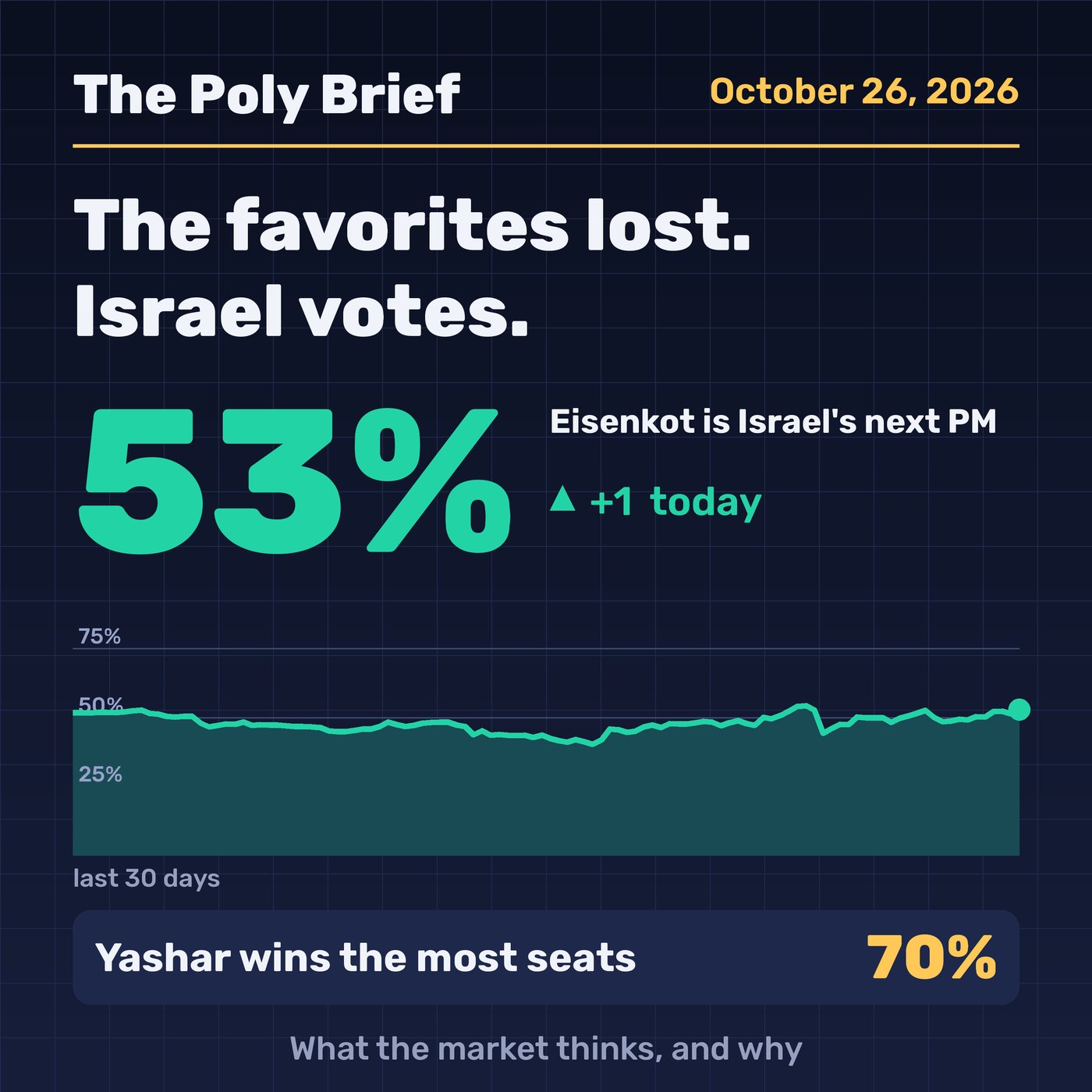
Then Israel, which votes tomorrow. The market gives Gadi Eisenkot 52.8% to be the next prime minister, up five points in a week, with Netanyahu at 26.5%. His party Yashar is at 70% to be the largest. Why, what the last polls before the ban said, the bloc math that leaves Arab parties out, and what keeps Netanyahu in office until a new government is sworn in. Market figures are not a survey based on recognized statistical methods, and the polls quoted are from Friday and outdated.
Listen to this episode
- Listen onApple Podcasts
- Listen onSpotify
- YouTubesoon
Markets in this episode
Odds at snapshot:
Prime Minister of Israel after the next election?
▲ +1 today+5 7 days
▼ −1 today−2 7 days
24h volume: $1.3M
Israeli Legislative Election Winner
▼ −2 today+3 7 days
▲ +2 today−3 7 days
24h volume: $951K
Israel Election: Which Bloc Wins More Seats?
▼ −1 today+8 7 days
▲ +1 today−8 7 days
24h volume: $11K
Transcript
Read the full transcript
Cold open
Maya: Yesterday we ended the show with this: one time in five, the underdog wins. And on a night like this, one in five happens.
Daniel: It happened twice. Brazil and Serbia. Two favorites, two losses, one night.
Maya: This is The Poly Brief. It's Monday, October twenty sixth. I'm Maya.
Daniel: And I'm Daniel. Every day we take the biggest moves on Polymarket, show you where the odds stand, and ask: why is the market betting this way?
Maya: Today, a big Who Called It. Spoiler: not the market, and not us. And then Israel, which votes tomorrow. Let's go.
Story 1: Who Called It
Maya: Story one. Who called it? Brazil first. Yesterday morning, the market gave Flávio Bolsonaro seventy nine point nine percent. On Saturday evening, almost eighty four. Earlier this month, eighty five point seven.
Daniel: And the result, from the electoral court, with every vote counted: Lula, fifty one point eight percent. Flávio, forty eight point two. A margin of about four point four million votes.
Maya: Ouch.
Daniel: And it's historic. In the first round, Flávio came first. In Brazil, a runner-up had never come back to win the runoff. Until last night.
Maya: Yesterday I said Brazil's most reliable poll is the calendar. So that's another one for the list of things I said.
Daniel: And there's a twist inside the twist. There was a separate market on the margin. Lula winning by less than four points was priced at seventeen percent. That's exactly what happened. The traders' third choice.
Maya: So what did the market get wrong?
Daniel: The polls, mostly. The final polls had Flávio ahead, fifty one to forty nine. The traders went further, because in the first round the polls had underestimated Flávio by about three points. They bet the polls would miss toward Flávio again.
Daniel: The polls did miss. The other way. Ten final polls averaged about fifty one for Flávio. He got forty eight. On the gap between the two, that's a miss of more than five points.
Maya: Where did Lula find the votes?
Daniel: Everywhere. He gained votes in every single state. Turnout went up, from seventy nine percent in the first round to almost eighty one. And Minas Gerais was the only state that changed sides. This time it went to Lula.
Maya: And the market? When did it figure it out?
Daniel: Before the count, actually. Late in the afternoon, a Supreme Court justice extended voting by two hours at stations that were still open, citing transport problems and the weather. Flávio called that something that had never happened in Brazil's history.
Daniel: And Polymarket moved within minutes. Flávio went from seventy six to sixty five. Lula passed fifty percent soon after the polls closed. By the end of the night, Flávio's shares were worth almost nothing. About two hundred fifty million dollars traded on that market.
Maya: And what now?
Daniel: Lula said: this victory isn't mine, it's yours. Flávio said it's impossible to recognize the result, and that he will ask to annul the election. No formal challenge has been reported yet.
Daniel: Lula takes office on January fifth. His fourth term. He'll be the oldest president Brazil has ever sworn in. And he turns eighty one tomorrow.
Maya: Some birthday present.
Maya: Now Serbia. Yesterday: Aleksandar Vučić's list at seventy one and a half to win the most seats. The students' list at twenty eight and a half.
Daniel: And the result. The projection from the CeSID and Ipsos parallel count: the students fifty three percent, Vučić's list thirty nine. About a hundred and forty seats out of two hundred fifty. A majority on their own.
Maya: Not even close.
Daniel: Not even close. And Vučić conceded about an hour and a half after the polls closed. Quote: it is clear that we have lost these elections, the Student List has won.
Daniel: Turnout was close to seventy percent. According to Reuters, the highest since Yugoslavia broke up. Yesterday we quoted an analyst who said that above four point two million voters, the government is in trouble. Seventy percent of six and a half million is about four and a half million.
Maya: And we said the market is betting on incumbency and the students on turnout. Turnout won.
Daniel: And now a confession. Yesterday our reason number one for the market was the last poll. Ipsos, Vučić ahead forty seven to forty. What we didn't tell you: that poll was commissioned by Vučić's own list. It's right there in the report. We should have said it.
Maya: Noted. And how far off was it?
Daniel: On the gap between the two lists, about twenty points. A Serbian weekly, Nedeljnik, asked whether it was the worst pre-election poll in history.
Maya: The other side. Was the market actually wrong? Or did two unlikely things just happen?
Daniel: Fair question. Eighty percent means one time in five, the other side wins. If the two races were unrelated, both upsets together would be around six percent. Rare. Not impossible.
Daniel: But they weren't really unrelated. In both, the market leaned on the polls, and on a story about which way the polls would miss. In Brazil, the story was: the polls always underrate the Bolsonaros. In Serbia: the incumbent always has the machine. Both stories were wrong on the same night.
Maya: Bottom line: a price is a crowd's best guess, and last night the crowd guessed the polls would miss the same way they did last time. They didn't. Keep that in mind, because Israel votes tomorrow.
Daniel: And if you want to be here on Wednesday to find out who called that one, hit follow. It's free, and our track record is, let's say, honest.
Bridge
Maya: Daniel, why do you have two umbrellas?
Daniel: One for today. One for tomorrow. They say it's going to pour.
Maya: You know you can use the same umbrella twice.
Daniel: Not mine. Mine lives on a bus somewhere in the north.
Maya: So you're hedging. Very on brand for this show.
Daniel: Two umbrellas, two outcomes. I'm covered either way.
Maya: Well, tomorrow millions of people go out in that rain to vote. And the market already has a favorite.
Story 2: Israel
Maya: Story two. The board. Israel's next prime minister. Gadi Eisenkot: fifty two point eight percent. Benjamin Netanyahu: twenty six and a half. Naftali Bennett: twelve and a half.
Daniel: Eisenkot is up more than five points in a week. A week ago, on this show, he was at forty six. About fifty four million dollars have traded on this one.
Daniel: And two more boards. Which party wins the most seats: Eisenkot's party, Yashar, seventy percent. Likud, twenty nine and a half. And which bloc wins more seats: the opposition, fifty six and a half. Up eight in a week.
Maya: Quick legal note, because the law in Israel asks for it during the poll ban: these market numbers are not a survey based on recognized statistical methods. They're prices.
Daniel: And the polls we're about to quote are from Friday, the last day polls could be published. So they're outdated.
Maya: A disclaimer for the disclaimer. Okay. What did Friday's polls say?
Daniel: Four final polls, from Channel Thirteen, Channel Twelve, Kan and Maariv. Yashar between twenty one and twenty three seats. Likud between nineteen and twenty one. Bennett's party, Together, fourteen or fifteen. Yashar ahead in all four.
Daniel: And the blocs, counted the way the market counts them: the opposition between fifty two and fifty six seats. Netanyahu's bloc between forty eight and fifty. Nobody at sixty one. Nobody close.
Maya: So why does the market make Eisenkot the favorite, if nobody has a majority?
Daniel: Reason one: he's ahead everywhere. Largest party in every final poll, and in Maariv's head to head, Eisenkot forty nine, Netanyahu forty one.
Daniel: Reason two: Netanyahu's path to sixty one looks narrow. His bloc is eleven to thirteen seats short in the polls. Several parties outside it have said no to him. Avigdor Lieberman's slogan is literally: Likud, yes. Netanyahu, no. And Yair Golan of the Democrats says he won't sit with Netanyahu and his partners.
Maya: And reason three?
Daniel: The swing votes. The Haredi parties, Shas and United Torah Judaism, have about fifteen seats between them. A Shas lawmaker, Moshe Maya, put it this way: not Bibi and not Eisenkot. Whoever will give more.
Daniel: And here's a detail in the fine print. In the bloc market, the Arab parties count for neither side. They polled fourteen to sixteen seats. So the opposition can win the bloc market and still be far from a government. And Eisenkot has said he won't make an alliance with the Arab parties.
Maya: The other side. What keeps Netanyahu at twenty six, and maybe higher?
Daniel: First, the rule. This market pays only for a prime minister who is sworn in. Not a caretaker. If nobody can form a government, Israel goes to another election early next year, and Netanyahu stays in office in the meantime. In this market, that's not a win for anyone. But it's not a loss for him either.
Daniel: Second, the polls have missed in Israel before. In twenty twenty two, the final polls gave Netanyahu's bloc about sixty seats. It got sixty four.
Maya: And after last night, a polling miss doesn't sound so theoretical.
Daniel: Exactly. Third, the opposition hasn't agreed on one candidate. Bennett is in the race for the top job too. And fourth, the threshold. Ofer Winter's party polled just under it. If it gets in, its seats count for Netanyahu's bloc.
Daniel: And Donald Trump weighed in again this weekend: vote for Bibi Netanyahu for prime minister, we have to finish the job.
Maya: And how much should we trust the market itself?
Daniel: Good question. Researchers from the University of Haifa and Columbia, quoted in Israel Hayom, found that a hundred fifty two dollars once put Eisenkot at the top of Polymarket's rankings. And one purchase of a hundred thousand dollars pushed Netanyahu from twenty nine and a half percent to thirty six. For about two hours.
Maya: A hundred fifty two dollars. That's a nice dinner in Tel Aviv. Without wine.
Maya: What to watch. Polls open tomorrow at seven in the morning and close at ten at night. That's when the exit polls come out. About seven point three million Israelis can vote, and the forecast is rain and thunderstorms.
Maya: Then the count overnight, official results scheduled for November fourth, and then the President's consultations. Whoever gets the mandate has twenty eight days, plus two weeks if needed. We'll be back on Wednesday to see who called it.
Maya: Bottom line: the market thinks Eisenkot's lead is real. The open question is whether he can turn a lead into sixty one. And last night was a reminder: a lead in the polls is a forecast, not a result.
Close
Maya: That's The Poly Brief for today. Every article and number is linked in the description.
Daniel: And a reminder: these odds are prices, not prophecies. Nothing here is investment advice. Eisenkot at fifty three means that almost half the time, someone else ends up prime minister. As Brazil and Serbia just showed us.
Maya: If you liked it, follow or subscribe, give us a rating, and send it to the friend who keeps losing umbrellas.
Daniel: We're here every morning. See you tomorrow!
Sources
- Polymarket: Brazil Presidential Election (2026-10-26)
- Polymarket: Brazil Presidential Election Second Round: Margin of Victory (2026-10-26)
- CNN Brasil: Lula bate o próprio recorde e é o presidente mais votado da história (2026-10-25)
- CNN Brasil: Lula será o presidente mais velho, quebrando o próprio recorde (2026-10-25)
- Revista Oeste: Confira os números do 2º turno, com 100% da apuração concluída (2026-10-26)
- Metrópoles: Lula conquista virada inédita no segundo turno e é reeleito para 4º mandato (2026-10-25)
- Times Brasil | CNBC: Entenda em números como aconteceu a virada inédita na eleição brasileira (2026-10-25)
- Exame: Lula amplia votação em 13 estados e vira em Minas Gerais no 2º turno (2026-10-25)
- Poder360: Vitória de Lula foi por alta em São Paulo, Minas, Rio e Bahia (2026-10-26)
- Terra: Saiba quais foram os momentos de virada na apuração do 2º turno entre Lula e Flávio Bolsonaro (2026-10-25)
- Bloomberg Línea: Ao vivo: Brasil vota no 2º turno para escolher entre Lula e Flávio Bolsonaro (2026-10-25)
- O Povo: Flávio Bolsonaro diz que não reconhece resultado (2026-10-25)
- Mix Vale: Flávio Bolsonaro não reconhece derrota e pede anulação do 2º turno (2026-10-25)
- Rede 98: "Essa vitória não é minha, é de vocês", diz Lula em discurso na Avenida Paulista (2026-10-26)
- CBS News (AP): Lula wins fourth term as Brazil's president, beating Flávio Bolsonaro in runoff (2026-10-25)
- The Rio Times: Why Flávio's Polymarket Odds Collapsed (2026-10-25)
- Polymarket: Serbia Parliamentary Election Winner (2026-10-26)
- Times of Israel (Reuters): Serbia's Vucic concedes election defeat in historic win for student protest movement (2026-10-26)
- RFE/RL: Vucic Concedes Electoral Defeat, Setting Stage For New Era Of Serbian Politics, Relations With West (2026-10-26)
- CBS News (AP): Aleksandar Vucic concedes defeat in Serbia's parliamentary election, marking political shift (2026-10-25)
- Nedeljnik: Najgora predizborna anketa u istoriji? Kako je - i zašto - IPSOS promašio za 20% (2026-10-26)
- Telegraf: CESID objavio: konačna projekcija raspodele mandata, na osnovu 96 odsto obrađenog uzorka (2026-10-26)
- RTS: Ipsos: Ujedinjena Srbija 47,4, Studentska lista 40 odsto (2026-10-22)
- Danas: Izbori 2026: rezultati, glasanje uživo (2026-10-25)
- N1: Blog: Srbija, vanredni parlamentarni izbori 25. oktobar 2026 (2026-10-25)
- Polymarket: Prime Minister of Israel after the next election? (rules) (2026-10-26)
- Polymarket: Israeli Legislative Election Winner (rules) (2026-10-26)
- Polymarket: Israel Election: Which Bloc Wins More Seats? (rules) (2026-10-26)
- Israel Hayom: Israel warns of illegal election polls ahead of vote (2026-10-20)
- Times of Israel: Final polls before election show both blocs short of majority, small parties out of Knesset (2026-10-24)
- Ynetnews: Final Israel election polls put Eisenkot's Yashar ahead of Likud, but neither bloc wins a majority (2026-10-23)
- Jerusalem Post (Maariv): Netanyahu bloc falls to 48 seats as opposition reaches 54, days before election - poll (2026-10-23)
- Ynetnews: 'Why vote for me?' Israel's party leaders make their final pitch to voters (2026-10-25)
- Ynetnews: Final 100 hours: Netanyahu rallies Likud strongholds as Eisenkot and Bennett chase swing voters (2026-10-23)
- Times of Israel: Eisenkot warns at campaign rally: Netanyahu will 'stop at nothing' to stay in power (2026-10-26)
- Times of Israel: 'We have to finish the job': Trump doubles down on Netanyahu support (2026-10-26)
- News4Jax (AP): Israel's Arab-led parties could decide the election if anyone would partner with them (2026-10-16)
- Times of Israel: Eisenkot said to propose to opposition chiefs they all agree to nominate leader of largest party for PM (2026-05-31)
- Times of Israel: The final countdown: What could change the election in the last days (2022-10-30)
- IDI: The 2022 Elections: Results Analysis (2022-11-07)
- IDI: Elections 2026 (2026-10-26)
- Jerusalem Post: How to vote in Israel: A guide for the first-time voter (2026-10-20)
- Jerusalem Post: Israel braces for rainy Election Day, but can bad weather affect voter turnout? (2026-10-25)
- The Media Line: Israel's Election Results Certified, President Begins Consultations (2022-11-09)