· 10 min
Oct 13: Netanyahu slides, Bennett climbs, and the Fed's next move
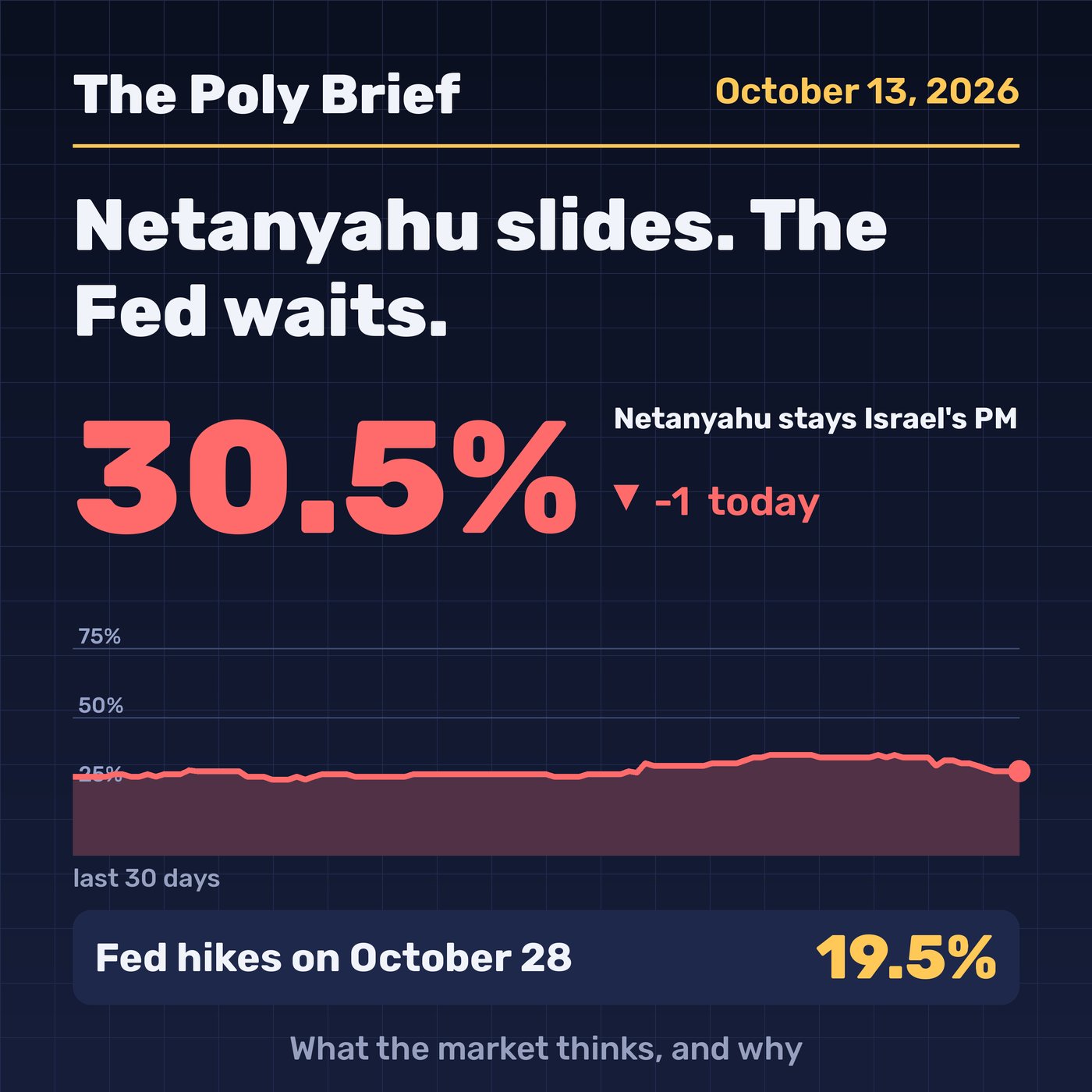
Two weeks to Israel's election: Gadi Eisenkot is back to 47% on Polymarket after dipping to 41 on Sunday, Benjamin Netanyahu fell to 30.5%, down six points since Thursday, and Naftali Bennett climbed to 14%. A safety-net offer from the Joint List, a sentence about Netanyahu as a minister that Bennett walked back the same day, and polls stuck around 52-52.
Plus the Fed: traders give a rate hike on October 28 a 19.5% chance, up three points overnight. Two weeks ago it was 64%. What crashed it, what could bring it back, and why Wednesday's inflation number matters more than anything Fed officials say this week.
Listen to this episode
- Listen onApple Podcasts
- Listen onSpotify
- YouTubesoon
Markets in this episode
Odds at snapshot:
Prime Minister of Israel after the next election?
▲ +1 today+0 7 days
▼ −1 today−5 7 days
24h volume: $233K
Fed Decision in October?
▼ −3 today
▲ +3 today
24h volume: $1.5M
Transcript
Read the full transcript
Cold open
Maya: On Thursday, the market gave Benjamin Netanyahu thirty six and a half percent to be Israel's next prime minister.
Daniel: This morning, thirty and a half. And the man who climbed the most this week isn't even in the top two in the polls.
Maya: This is The Poly Brief. It's Tuesday, October thirteenth. I'm Maya.
Daniel: And I'm Daniel. Every day we take the biggest moves on Polymarket, show you where the odds stand, and ask: why is the market betting this way?
Maya: Today: Israel, two weeks before the vote, where Netanyahu is sliding and Naftali Bennett is quietly climbing. Then the Fed, and a rate hike the market keeps pricing in and out.
Story 1: Israel
Maya: The board. Israel's next prime minister. Gadi Eisenkot, forty seven percent. Benjamin Netanyahu, thirty and a half. Naftali Bennett, fourteen.
Daniel: About forty six million dollars have traded here. And the moves are big. On Sunday, when we last covered this, Eisenkot was at forty one. Netanyahu is down six points since Thursday. Bennett was at eight and a half last Thursday. He's almost doubled.
Maya: So what happened over the weekend?
Daniel: Two things with timestamps. First, Saturday evening. Yousef Jabareen, who leads the Joint List, one of the Arab parties, posted a video offering what he called a safety net. His party could let a government that replaces Netanyahu take office, for example by abstaining in the confidence vote.
Daniel: With conditions. A plan against crime in Arab towns, an end to home demolitions, recognition of villages in the Negev, and a political horizon for the Palestinians. And in his words: not a blank check.
Maya: And Eisenkot's number?
Daniel: Sunday morning, forty and a half. By Sunday night, forty five and a half. Now forty seven. The timing fits. Nobody has shown that the video is the reason.
Maya: And the second thing?
Daniel: Bennett. On Sunday, at a conference, he said he has no problem with Netanyahu serving as a minister in his government. If Netanyahu accepts a state commission of inquiry, a draft for everyone, and a constitution.
Maya: Hm. How did that go over?
Daniel: Eisenkot said no. Liberman said no. Yair Golan said no. Bennett backtracked the same day. And Yair Lapid, his own number two, called it unsuccessful irony.
Maya: As a podcast that tries to be ironic every morning, we feel that one.
Maya: So why does the market still put Eisenkot first, but under fifty?
Daniel: Reason one: Eisenkot's party, Yashar, leads or ties almost every poll. The Kan poll on Sunday: Yashar twenty two seats, Likud twenty, Bennett's party twelve.
Daniel: Reason two, and this is why he's under fifty: the blocs. That same Kan poll has Netanyahu's bloc at fifty three and Eisenkot's at fifty. Channel thirteen last week, fifty five to fifty for Netanyahu. Channel twelve, fifty four to forty nine for the opposition. Nobody gets to sixty one.
Maya: So the polls agree on one thing. Nobody wins.
Daniel: Reason three, and that's where Bennett's fourteen comes from. When nobody has sixty one, someone has to build a bridge. A Jerusalem Post analysis on Monday says people in Likud see Bennett as the only opposition figure who might deal with them. It also says no talks have taken place. And President Herzog said he'll do everything in his power to prevent another round of elections.
Maya: So Bennett is the compromise bet.
Daniel: Exactly. Not the favorite. The fallback.
Daniel: And in the background, the affair of Avi Gil, Netanyahu's military secretary on October seventh. Last Thursday he alleged an attempt to change the logged time of his first call with the prime minister that morning. Likud calls it politically motivated. Eisenkot gave the attorney general until Friday to decide on charges against a Netanyahu aide.
Maya: Now the other side. What could flip this?
Daniel: For Netanyahu: the blocs. In two of the last three big polls, his camp is ahead. Likud's goal, according to the Jerusalem Post, is fifty five or fifty six seats. Enough to block any government that doesn't rely on the Arab parties.
Daniel: And that's the catch for Eisenkot. A government that depends on the Joint List is a hard sell to a lot of his own voters. Bennett and Lapid say they won't sit with Netanyahu. But two weeks is a long time in Israeli politics.
Daniel: And one more number from Kan. Thirty percent of voters are still undecided.
Maya: What to watch. Election broadcasts start on TV and radio today. Friday, the deadline Eisenkot gave the attorney general. The election is October twenty seventh, and we'll be back the morning after to see who called it.
Maya: Bottom line: Eisenkot is the favorite, but under fifty. The market is saying the polls can tell you who finishes first, not who builds a government.
Daniel: And if you want to hear how it ends before your group chat does, hit follow. It's free, and it's the only commitment in this episode without conditions.
Bridge
Maya: Daniel, is that your second coffee already?
Daniel: Third. The first one went cold while I was reading poll tables. The second one too.
Maya: Election season.
Daniel: And on the way in, the traffic was crawling, and the car next to me had a campaign jingle on full blast. Seven in the morning, windows down.
Maya: Broadcasts start today. Get used to it.
Daniel: And the coffee place raised prices again. Same cup, more shekels.
Maya: Funny you say that. Because prices that keep going up are exactly what they're worried about in Washington right now.
Story 2: The Fed
Maya: Story two. The board. The Federal Reserve's decision on October twenty eighth. No change, eighty and a half percent. A rate hike of a quarter point, nineteen and a half. Up three points overnight. A cut, half a percent.
Daniel: About thirty four million dollars traded. When we covered this on October fifth, no change was at eighty three and a half. But look at the last month. On September twenty eighth, a hike was at sixty four and a half. Five days later, seventeen and a half.
Maya: Wait. A hike? I thought everyone was talking about cuts.
Daniel: Not this year. In September, the Fed raised rates to between three and three quarters and four percent. Unanimous. The first hike since July twenty twenty three. Chair Kevin Warsh said inflation is too high, and has been for too long.
Maya: So what crashed the October hike from sixty four to seventeen?
Daniel: Three days of Fed officials talking, and one jobs report. First, two senior officials, New York Fed president John Williams and vice chair Philip Jefferson, said there's no need to rush. Then on October second, the jobs report: just twenty nine thousand new jobs in September. Unemployment up to four point two percent. And July was revised down to minus ten thousand.
Maya: So the Fed spoke for three days and the market moved fifty points. Imagine if they'd actually done something.
Daniel: Reason one for the hold, then: the weak labor market. Reason two: core inflation, without food and energy, was two point four percent in August. That's not a fire.
Daniel: Reason three: even the hawks aren't in a hurry. Fed governor Christopher Waller said on October eighth that more hikes are needed, but they don't have to come at back to back meetings.
Maya: Now the other side. Why is the hike still at nineteen and a half, and rising?
Daniel: Oil. Brent climbed above a hundred and six dollars a barrel on Monday after a deadly weekend strike on Riyadh's airport. At least sixteen people were killed. Gasoline in the US was up twenty seven percent from a year earlier in August. Headline inflation was three point four.
Daniel: And the Fed's own forecasts. In September, sixteen of eighteen officials projected at least one more hike this year. The minutes say most saw another increase as likely appropriate by year end. The question isn't if. It's October or December.
Daniel: We didn't find a Fed speech or a data release behind last night's three points. The timing matches the oil move. Nobody has tied them together.
Maya: What to watch. Tomorrow, Wednesday, at eight thirty in the morning New York time, September's inflation number. The Cleveland Fed's nowcast says three point six percent. From Saturday, the Fed goes into its blackout period. No public comments until after the decision.
Daniel: The only two weeks a year when Washington stops talking on purpose.
Maya: And the decision itself, October twenty eighth. Bottom line: the market thinks the Fed hikes again, just probably not this month. Tomorrow's number decides how loud that 'probably' is.
Close
Maya: That's The Poly Brief for today. Every poll, article and number is linked in the description.
Daniel: And a reminder: these odds are prices, not prophecies. Nothing here is investment advice. Eisenkot at forty seven percent means that, more often than not, someone else ends up prime minister. And he's still the favorite.
Maya: If you liked this one, follow or subscribe, leave us a rating, and send it to the friend who's still undecided. Statistically, you have at least one.
Daniel: We're here every morning. See you tomorrow!
Sources
- Polymarket: Prime Minister of Israel after the next election? (rules) (2026-10-13)
- Jerusalem Post: Kan poll: Netanyahu bloc 53, Eisenkot bloc 50 (2026-10-12)
- Jerusalem Post: Poll roundup: Maariv, Channel 12, Kan (2026-10-11)
- Times of Israel: Netanyahu-led bloc ahead of Zionist opposition parties with 55-50 seats in TV poll (2026-10-08)
- Times of Israel: ToI poll: Anti-Netanyahu bloc regains lead, Eisenkot's Yashar comes 1st (2026-10-08)
- Jerusalem Post: Joint List offers safety net, opening door for Eisenkot (2026-10-12)
- Ynetnews: Bennett says Netanyahu could serve as minister in his government (2026-10-11)
- Times of Israel: Bennett suggests Netanyahu could be part of future government, quickly backtracks (2026-10-11)
- Jerusalem Post: Lapid: Bennett remark was unsuccessful irony (2026-10-12)
- Jerusalem Post: Analysis: Likud eyes Bennett as only possible partner (2026-10-12)
- Times of Israel: Liveblog October 12, 2026 (Herzog) (2026-10-12)
- Times of Israel: Netanyahu's former military secretary alleges attempt to alter October 7 records (2026-10-08)
- Jerusalem Post: Eisenkot demands decision on Netanyahu aide's alleged record alteration (2026-10-10)
- Jerusalem Post: Echo of the past: Israel's election broadcasts hit TV on Tuesday (2026-10-12)
- Library of Congress: FALQs: Israel's upcoming election on October 27, 2026 (2026-10-09)
- Polymarket: Fed Decision in October? (rules) (2026-10-13)
- Federal Reserve: Federal Reserve issues FOMC statement (2026-09-16)
- Federal Reserve: Summary of Economic Projections, September 2026 (2026-09-16)
- Federal Reserve: Minutes of the FOMC, September 15-16, 2026 (2026-10-07)
- Kiplinger: September Fed Meeting: Live Updates and Commentary (2026-09-16)
- BLS: Consumer Price Index Summary (2026-09-11)
- BLS: The Employment Situation, September 2026 (2026-10-02)
- Tiger Brokers: Fed Officials' Remarks Sway Markets as Rate Hike Bets for October Tumble (2026-10-03)
- investingLive: Fed's Waller says more hikes are needed but can be flexible about the pace (2026-10-08)
- Admiral Markets: US CPI Preview: September 2026 Forecasts and the Core CPI Outlook (2026-10-08)
- Trading Economics: Brent crude oil (2026-10-13)
- Federal Reserve: FOMC Policy on External Communications of Participants (2026-10-13)