· 10 min
Oct 12: Le Pen slips, Philippe gets a TV bump, and the states that want to pause AI
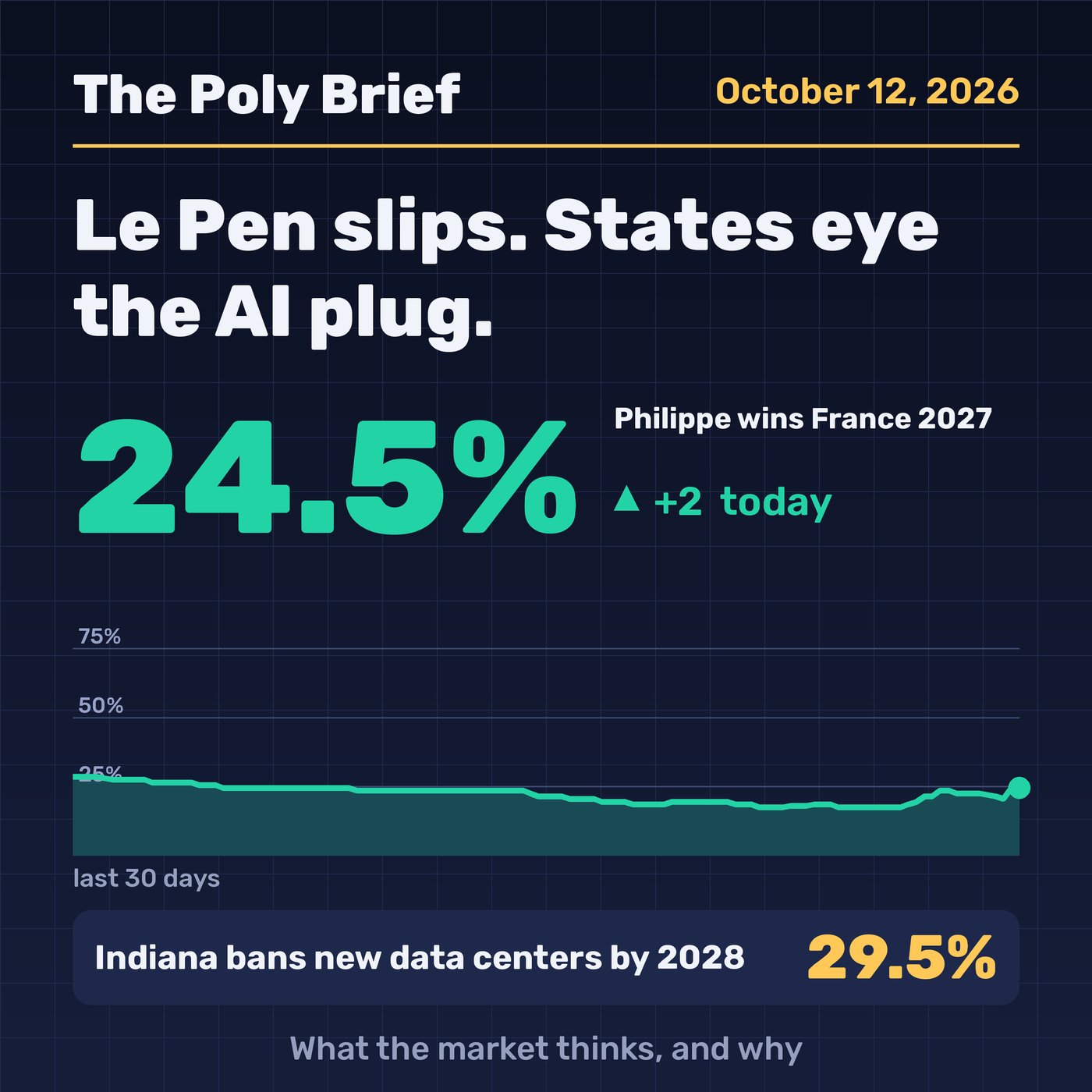
France, six months out: Marine Le Pen is still the favorite on Polymarket, but she's down to 39% from almost 46 a week ago. Édouard Philippe jumped to 24.5% the night he presented his program on France 2. What moved it, what the polls say, and why a court in Paris is the real wild card.
Plus a new board: will US states ban new data centers? Indiana jumped 14 points in a week to 29.5% (by 2028), and Texas by the end of 2027 rose 5 points in a day. Why New York's "first statewide moratorium" doesn't count, and why nothing can happen before January.
Listen to this episode
- Listen onApple Podcasts
- Listen onSpotify
- YouTubesoon
Markets in this episode
Odds at snapshot:
Next French Presidential Election
▼ −1 today−6 7 days
▲ +3 today+7 7 days
24h volume: $770K
Indiana enacts data center moratorium by...?
▲ +4 today+14 7 days
+1 7 days
24h volume: $101K
Texas enacts data center moratorium by...?
▲ +2 today+2 7 days
▲ +5 today+6 7 days
24h volume: $127K
Transcript
Read the full transcript
Cold open
Maya: A week ago, the market gave Marine Le Pen almost forty six percent to become France's next president.
Daniel: Tonight, thirty nine. And one TV interview moved her main rival four points in a single evening.
Maya: This is The Poly Brief. It's Monday, October twelfth. I'm Maya.
Daniel: And I'm Daniel. Every day we take the biggest moves on Polymarket, show you where the odds are, and ask: why is the market betting this way?
Maya: Today: France, where the favorite is slipping and the runner up just had a good night on TV. Then a brand new board. Will American states hit pause on AI data centers?
Story 1: France
Maya: The board. France's presidential election, April twenty twenty seven. Marine Le Pen, thirty nine percent. Down five and a half points in a week.
Daniel: Édouard Philippe, the former prime minister, twenty four and a half. Up six and a half. Then David Lisnard, fourteen. And Jean-Luc Mélenchon, ten and a half. About a hundred and forty nine million dollars have traded here.
Maya: When we covered this a week ago, Le Pen was at forty three and a half and climbing. What turned?
Daniel: Two things, and both have a time stamp. First, Philippe. On Thursday evening he went on France 2's big interview show and laid out his program. That morning the market had him at seventeen and a half. By one in the morning, Israel time, twenty one and a half. The next day, twenty three and a half.
Maya: What did he promise?
Daniel: Cut legal immigration in half. Retirement at sixty five, with forty five years of contributions. Unemployment benefits cut from eighteen months to twelve. Two extra hours of work a week, for about a thousand euros more a year. And about twenty decrees in a special session of parliament in July.
Maya: So, a program. With actual numbers in it.
Daniel: In a campaign, that counts as news. The timing matches the jump. Nobody has shown that the interview is why.
Daniel: Second, Le Pen's camp. On September twenty eighth, Mediapart published messages it attributes to Jordan Bardella, her number two, with antisemitic remarks from about a decade ago. Bardella denies writing them and is suing. Le Pen stayed silent for three days, then said she has complete confidence in him.
Maya: And the market punished her for that?
Daniel: Here's the odd part. During the first week of the affair, her price actually went up, to almost forty six. The slide started only after that weekend. And on Thursday, a Cluster seventeen poll for Le Point had her approval down four points, and Bardella's down five.
Maya: So why does the market still have her in front, but at only thirty nine?
Daniel: Reason one, why she's in front: the polls. Ifop's latest has her first at thirty three percent. Philippe twenty one, Mélenchon sixteen. And she wins every runoff pollsters have tested.
Daniel: Reason two, why she's only at thirty nine: the courts. In July an appeals court upheld her conviction for misusing European Parliament funds. But it cut her ban from office, and counted what's left as already served. So she can run. She also got a year to be served under an electronic tag.
Daniel: She appealed to France's top court, and that freezes the sentence. The ruling could come by early April. The first round is April eighteenth. And back in February she said campaigning under house arrest is not possible.
Maya: So the favorite might find out if she's really running about two weeks before the vote.
Daniel: Reason three: the runoff. Philippe is her closest rival there. A Harris Interactive poll in September had her winning fifty seven to forty three. But an Elabe poll in July had it at fifty two to forty eight.
Maya: And Lisnard? A week ago we told you about two brand new wallets buying him up.
Daniel: Still at fourteen percent on Polymarket. In Ifop's poll, three and a half. So either the polls are badly missing the mayor of Cannes, or some people really like Cannes.
Maya: The film festival vote.
Maya: Now the other side. What could flip this?
Daniel: For Le Pen: she still leads every first round poll by double digits. Last week she raised her planned savings to a hundred and forty billion euros by twenty thirty two, a pitch aimed straight at the bond markets. One good day in court, and that thirty nine could look low.
Daniel: For Philippe: one evening isn't a campaign. L'Express described his campaign as out of step. A pension video he posted in September got about fifty four thousand views in three days. And in that same Cluster seventeen poll, he lost five points too.
Daniel: And one more thing. We haven't found a single vote intention poll with fieldwork in October. So the market is moving ahead of the polls.
Maya: What to watch. Thursday, October fifteenth, is the last deadline for briefs at the top court. Then the budget fight in parliament, and the first October polls. We'll come back after the first round in April to see who called it.
Maya: Bottom line: Le Pen is still the favorite, but the market now prices a judge in April as much as the voters.
Daniel: And if you want to know when that changes before your friends do, hit follow. It costs nothing, which is more than you can say for most things in this episode.
Story 2: Data centers
Maya: Story two. A new kind of board. Will an American state pass a law banning new data centers? Polymarket opened a market for several states two weeks ago.
Daniel: Indiana, by the end of twenty twenty eight: twenty nine and a half percent. Up fourteen points in a week. Texas, by the end of next year: twenty two and a half, up five in a day. And by the end of this year? Indiana three, Texas four and a half.
Maya: Fourteen points in a week. What happened in Indiana?
Daniel: As far as we can find, nothing. No bill, no statement from the governor. And look where the money is. The contract that jumped traded about six hundred thousand dollars. The Indiana contract for the end of twenty twenty seven traded about two point three million, and it moved one point.
Maya: So the loud number is the quiet market.
Daniel: Exactly. And these markets are young. When the Texas market opened, the June twenty twenty seven contract traded at sixty six percent. Four days later, fourteen.
Maya: Price discovery. Or, as the rest of us call it, panic.
Maya: Okay, but why is anyone betting on this at all?
Daniel: Reason one: the bills. In Indiana, according to a consumer group, power bills went up more than seventeen percent on average this year. And at least seventeen Indiana counties have temporary moratoriums. Indianapolis paused new data centers until at least the end of twenty twenty seven. The vote was twenty three to one.
Daniel: Reason two: the grid. In Texas, the grid operator has more than four hundred seventy gigawatts of requests to connect. That's more than five times the state's record peak. And about ninety percent of it is data centers, according to Governor Abbott.
Daniel: Reason three: politics. A Quinnipiac poll in March found sixty five percent of Americans oppose an AI data center in their own community. And when President Trump signed an order against state AI laws in December, it left laws about data center infrastructure out.
Maya: Now the other side. Why is it still mostly no?
Daniel: The fine print. Only a state law counts. Not a county, not a city, and not an executive order. New York's governor signed what was called the first statewide moratorium in July. By executive order. So for this market, it doesn't exist.
Maya: The first statewide moratorium in America, and the market says: never heard of it.
Daniel: Same in Texas. In August, Abbott paused approvals until the grid audits are done, and in September he added environmental permits. That's a directive, not a law. Doesn't count either. And in Maine, the legislature did pass a moratorium. The governor vetoed it.
Daniel: And the money. Meta is building a ten billion dollar campus in Indiana, Amazon eleven billion. Indiana's governor, Mike Braun, said he was surprised by all the local moratoriums, and that data centers lower property taxes.
Maya: What to watch. No state legislature is in regular session before January. Indiana and Texas both start on January twelfth. Texas's grid audit report is due December tenth. And in Texas, Abbott faces voters on November third, against a Democrat who says his pause doesn't go far enough.
Maya: Bottom line: the revolt against data centers is real, but so far it's local. The market is betting that statehouses move slower than county councils.
Close
Maya: That's The Poly Brief for today. Every poll, article and number is linked in the description.
Daniel: And a reminder: these odds are prices, not prophecies. Nothing here is investment advice. Le Pen at thirty nine percent means that, more often than not, she isn't France's next president. And she's still the favorite.
Maya: If you liked this one, follow or subscribe, leave us a rating, and send it to the friend whose electric bill just went up.
Daniel: We're here every morning. See you tomorrow!
Sources
- Polymarket: Next French Presidential Election (rules) (2026-10-11)
- Journal du Net: Edouard Philippe présente ses principales mesures pour la présidentielle de 2027 (2026-10-09)
- Euronews: Bardella hits back at Macron over antisemitism allegations (2026-09-30)
- Euronews: 'I have complete confidence in Jordan': Le Pen backs Bardella after three days of silence (2026-10-04)
- Cluster17 / Le Point: Baromètre des personnalités Le Point / Cluster17 - Octobre 2026 (2026-10-08)
- Ifop: Presidential Election Barometer wave 6 (2026-10-02)
- Euronews FR: Présidentielle 2027 : vers un duel Le Pen-Mélenchon, selon un sondage (2026-09-28)
- Elabe: Présidentielle 2027 (intentions de vote) (2026-07-11)
- Cyprus Mail (Reuters): Le Pen says she will appeal conviction, run for president in 2027 (2026-07-07)
- Business Day (Reuters): Appeal court upholds Le Pen conviction but revives 2027 presidential path (2026-07-07)
- Euronews: France's Marine Le Pen will not run in 2027 if court imposes ankle bracelet, she says (2026-02-26)
- Parlons Politique: Pourvoi de Marine Le Pen : ce que le calendrier judiciaire change pour la présidentielle de 2027 (2026-09-05)
- Le Club des Juristes: Marine Le Pen : qui maîtrise le calendrier devant la Cour de cassation ? (2026-07-09)
- The Star (Reuters): Le Pen eyes bond markets with promise of bigger spending cuts if far right win presidential vote (2026-10-06)
- L'Express (via Orange): Présidentielle 2027 : Edouard Philippe, la campagne à contretemps (2026-10-04)
- Wikipedia: 2027 French presidential election (2026-10-11)
- Wikipedia: Édouard Philippe (2026-10-11)
- Wikipedia: David Lisnard (2026-10-11)
- Polymarket: Indiana enacts data center moratorium by...? (rules) (2026-10-11)
- Polymarket: Texas enacts data center moratorium by...? (rules) (2026-10-11)
- WFYI: Nearly a third of Indiana counties have moved to restrict data centers (2026-07-06)
- WFYI: New data centers temporarily banned in Marion County (2026-08-20)
- WFIU / Indiana Public Media: Statehouse push for affordable power collides with data center growth (2026-05-22)
- Commercial Observer: New York Enacting Nation's First Statewide Data Center Moratorium (2026-07-14)
- Broadband Breakfast: New York Becomes First State to Impose Data Center Moratorium (2026-07-16)
- TechInsights: The Maine Event: America's First Statewide Datacenter Moratorium (2026-04-17)
- Texas Tribune: Data center approvals in Texas halted until audits completed, Gov. Greg Abbott says (2026-08-03)
- Texas Tribune: Gov. Greg Abbott broadens moratorium on data center approvals to include environmental permits (2026-09-21)
- HPPR (Texas Public Radio): Texas governor's data center moratorium prompts calls for special legislative session (2026-08-07)
- Texas Public Radio: 'A long game': When is the best time to initiate a data center moratorium in Texas? (2026-10-09)
- Governing (Texas Tribune): Texas' Data Center Boom Is Creating a New Political Problem (2026-06-03)
- WFYI / Indiana Public Radio: At a pivotal moment for data centers, Indiana lawmakers take little action (2026-03-02)
- ABC57: Gov. Mike Braun surprised at amount of data center moratoriums (2026-07-29)
- Latitude Media: Trump's AI executive order won't slow the surge of state data center laws (2025-12-17)
- US Department of Energy: DOE Releases New Report Evaluating Increase in Electricity Demand from Data Centers (2024-12-20)
- MultiState: 2027 Legislative Session Dates (2026-10-11)