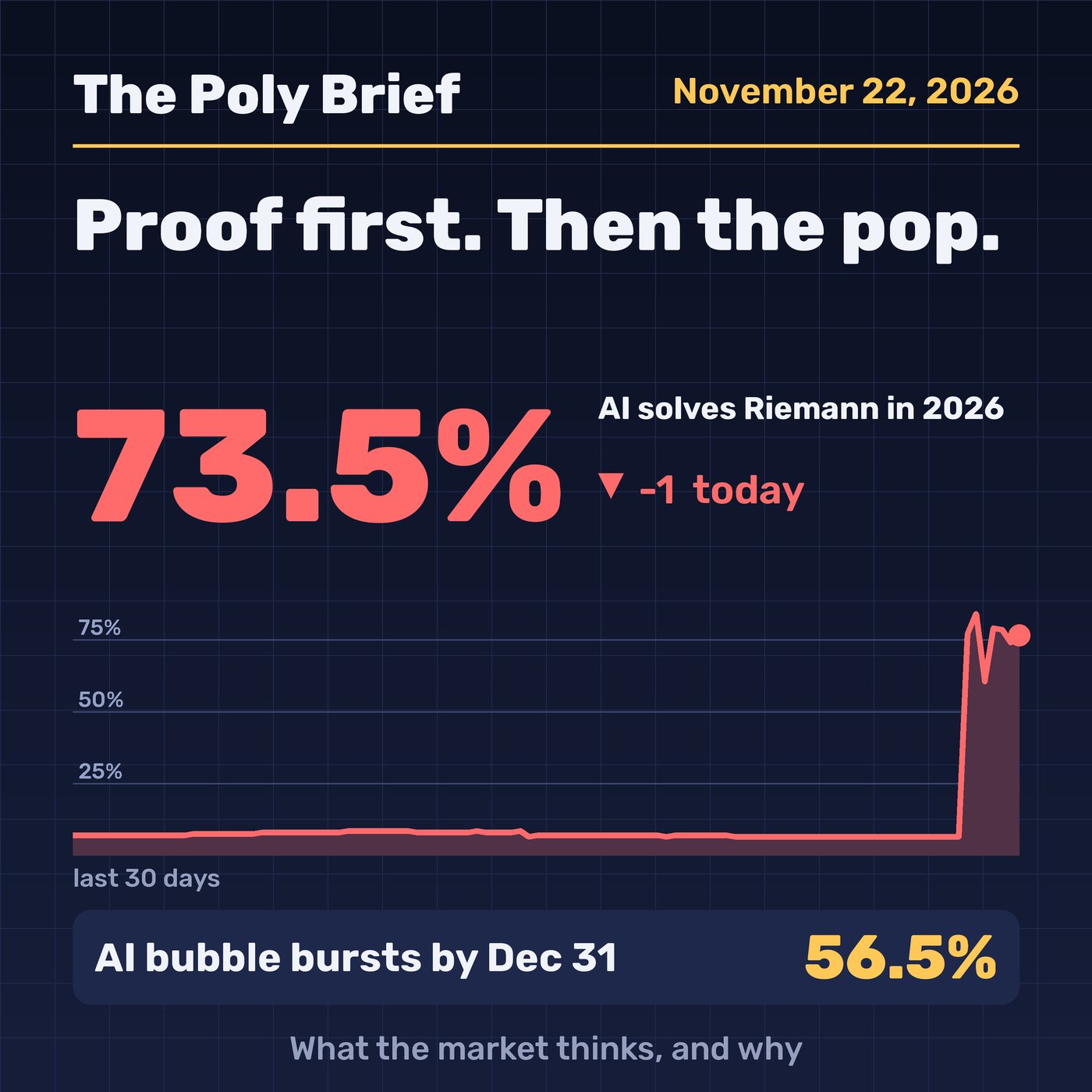
Nov 22: Claude and the Riemann Hypothesis, and the AI bubble checklist
An Anthropic mathematician, Levent Alpöge, posted a proof of the Riemann Hypothesis that he says he found with Claude: 17 million lines of Lean, and no paper. Polymarket's "AI solves the Riemann Hypothesis in 2026" jumped from 6.5% to 73.5% in a week. Why not 99? Three markets, three answers: the proof gets independently verified at 93%, an official lab announcement at about 71%, and the Clay Institute calling it solved this year at 2.8%. The rules want the lab to say it. Anthropic hasn't.
Then the AI selloff. "AI bubble burst by December 31" went from 8% to 56.5% after a Friday when the Nasdaq fell more than 5%. The bubble isn't a vote, it's a checklist: three of six events in 90 days. We go through the list. Plus Who Called It: Anthropic's first close, and Trump's words in Shenzhen.
Listen to this episode
- Listen onApple Podcasts
- Listen onSpotify
- YouTubesoon
Markets in this episode
Odds at snapshot:
Which math problems will AI solve in 2026?
▼ −1 today+67 7 days
▼ −1 today+2 7 days
24h volume: $110K
AI bubble burst by...?
▼ −8 today+49 7 days
▼ −2 today+49 7 days
24h volume: $103K
Anthropic closes below IPO price ($83) by...?
▼ −7 today
▼ −5 today
24h volume: $114K
Transcript
Read the full transcript
Cold open
Maya: A hundred and sixty seven years ago, a German mathematician wrote down a guess about prime numbers. Nobody could prove it.
Daniel: This week, someone posted a proof. Seventeen million lines of code, written with an AI. And the odds on Polymarket? Still only seventy three percent.
Maya: This is The Poly Brief. It's Sunday, November twenty second. I'm Maya.
Daniel: And I'm Daniel. Every day we take the biggest moves on Polymarket, show you where the odds stand, and ask: why is the market betting this way?
Maya: Today: the Riemann Hypothesis, and why the market believes the proof more than the press release. Then a very bad Friday for AI stocks, and a bubble with a checklist. But first, who called it.
Who called it
Daniel: Who Called It. Anthropic's first day on the Nasdaq. On Thursday morning we told you the market's favorite for the closing value: one point two five to one point five trillion dollars, at fifty two point six percent.
Daniel: According to the AP, the stock opened at a hundred eleven fifty, and closed at ninety seven seventeen. Seventeen percent above the IPO price. Times about thirteen point oh nine billion shares, that's roughly one point two seven trillion.
Maya: And the line was ninety five fifty.
Daniel: So the market called it. With a dollar sixty seven to spare.
Maya: And Shenzhen?
Daniel: We said eighty four and a half for nuclear, and eighty three for Iran. Both settled yes. According to the AP, in the three way meeting Trump said the three countries are uniquely positioned to discuss how to reduce the number of nuclear weapons on Earth.
Daniel: Ukraine, at forty five and a half, also settled yes. Diesel? No. Japan? No. And Elon Musk, who flew all the way to China? Settled no.
Maya: So the right room after all. Mostly.
Story 1: Riemann
Maya: Story one. And full disclosure, bigger than usual today. This script is written with Claude. Claude is the AI model in this story, and Anthropic, the company that makes it, is in both of our stories. So we stick to outside reporting, and to the rules of the market.
Maya: The odds. Will an AI lab announce a solution to the Riemann Hypothesis by the end of this year? Seventy three and a half percent. A week ago: six and a half.
Daniel: And it happened in one hour. Friday, around ten in the morning Eastern, it went from single digits to almost fifty.
Maya: Quick reminder for the rest of us. What is the Riemann Hypothesis?
Daniel: Bernhard Riemann proposed it in eighteen fifty nine. It's about how the prime numbers are spread out. The Clay Mathematics Institute put a million dollars on it. One of seven Millennium Prize Problems. Only one has ever been solved.
Maya: And who says it's solved now?
Daniel: Levent Alpöge, a mathematician who works at Anthropic. He posted a four page note on his personal website. The first line: I believe I have, working with Claude, discovered a proof of the Riemann Hypothesis.
Daniel: There's no paper. The whole proof is written in Lean, a programming language that checks every step of a proof. About seventeen million lines. He says a written version would run past two hundred fifty thousand pages.
Maya: So, a light read.
Maya: So what do mathematicians say?
Daniel: Andrew Sutherland, at MIT, has been running it through checkers. His page says it compiles with zero errors, and several independent checkers accept it. Some checks were still running overnight.
Daniel: He told The Next Web the chance that anything is fishy here is approximately zero. James Maynard, of Oxford, a Fields Medal winner, put it at ninety eight or ninety nine percent.
Maya: So if the experts are at ninety eight, why is the market at seventy three?
Daniel: Because the market isn't asking if the proof is right. Read the rules. An eligible AI lab, or its official representative, has to announce the solution, and present it as the work of the lab.
Daniel: And this came from one employee, on a personal site. The note never names Anthropic. He writes that he's clearly unilaterally responsible for not waiting longer. And Anthropic didn't answer the AP.
Maya: So the math might be done. The paperwork isn't.
Daniel: And you can see it in three other markets. Will the Lean proof be independently verified this year? Ninety three percent. Will Anthropic announce a Millennium Prize solution this year? About seventy one. Will the Clay Institute declare the Riemann Hypothesis solved this year? Two point eight percent.
Maya: Ninety three, seventy one, and three. Same proof.
Daniel: Three different questions. The Clay rules need publication and then a two year wait. So FelloAI and others say the earliest prize is late twenty twenty eight.
Maya: The other side. What could take this down?
Daniel: Not everyone likes how it came out. Brian Conrad, of Stanford, told The Next Web that releasing a proof the author doesn't fully understand is frankly completely outrageous. And according to the AP, the president of the Clay Institute, Martin Bridson, called it historically significant, but said the road to really understanding it will be long.
Maya: And the case for yes?
Daniel: Anthropic only has to say it. One blog post, before December thirty first. And traders give that about seventy one percent.
Maya: What to watch. The last checks at MIT. And any word from Anthropic. None is scheduled.
Maya: Bottom line: seventy three and a half percent isn't a bet on the math. It's a bet that a company says one sentence out loud. We'll check back at the end of the year.
Daniel: And if you're here for the fine print, tap follow. There's a lot more of it coming.
Bridge
Maya: My neighbor's kid got a bubble machine this weekend.
Daniel: Oh no. On the balcony?
Maya: Seven in the morning. The whole street was full of bubbles.
Daniel: Did you go out there and pop them?
Maya: I tried. They kept getting bigger.
Daniel: Funny. That's exactly what traders spent Friday arguing about.
Story 2: AI bubble
Maya: Story two. The odds. Will the AI bubble burst by December thirty first? Fifty six and a half percent. A week ago, eight. By the middle of next year: sixty seven percent.
Daniel: And two weeks ago, after another bad day on the Nasdaq, we told you eight and a half for this year. So that number didn't age well.
Maya: What happened on Friday?
Daniel: According to TradingKey, the Nasdaq fell five point two eight percent. That wiped out its gain for the year. The S and P five hundred fell three point seven. And the chip index fell almost eleven percent. All thirty stocks in it, down.
Maya: And Anthropic?
Daniel: Down eight and a half percent on Friday, to eighty eight dollars and ninety one cents. And Fortune reported that during the day it touched eighty three dollars and five cents. Five cents above the IPO price.
Maya: Five cents.
Daniel: And there's a market for that too. Will Anthropic close below eighty three dollars by Friday? Forty one percent. By the end of the year? Seventy five.
Maya: So why is the market pricing a burst? Who decides what a burst is?
Daniel: That's the good part. The bubble isn't a vote. It's a checklist. Six events, and three have to happen within ninety days.
Daniel: One: Nvidia closes fifty percent below its record. Two: the big chip ETF closes forty percent below its record. Three: OpenAI or Anthropic goes bankrupt. Four: OpenAI gets bought. Five: renting an Nvidia H one hundred chip falls to a dollar an hour. Six: one of five big hardware suppliers falls fifty percent.
Maya: Okay. Where are we?
Daniel: Number one. Nvidia's highest close was two hundred thirty nine dollars, on October sixth. Friday's close is forty seven and a half percent below that. So it needs about five percent more.
Daniel: Number two. The chip index closed Friday forty two and a half percent below its June record, according to SimianX. The ETF in the rules tracks that index. So that one looks crossed. Polymarket hasn't said so.
Daniel: Number six. Super Micro, the server maker, is one of the five. It's down more than eighty percent from its twenty twenty four peak. But it's been down there for over a year.
Maya: So does a line you crossed a long time ago count as happening in the last ninety days?
Daniel: The rules don't say clearly. And that question might be worth a few billion dollars of AI optimism.
Maya: So we could be one bad Nvidia day away from a bubble. Officially.
Daniel: And why is Nvidia falling? Reuters reported on Friday, via TradingKey, that SEC staff are reviewing possible accounting issues there. No wrongdoing has been found. And according to Finimize, traders see a Fed rate hike in December as almost certain.
Maya: The other side. Why might it not burst?
Daniel: The business underneath. Nvidia's revenue last quarter more than doubled from a year ago. And renting an H one hundred costs three dollars and six cents an hour, according to SiliconData. And that price has been rising. Line five is nowhere close.
Daniel: Nobody is near bankruptcy, and nobody is buying OpenAI.
Maya: So the checklist could fill up from stock prices alone. Even if the AI business is booming.
Daniel: That's the bet. It measures the bubble in prices. Not in chips.
Maya: What to watch. A short week. Markets are closed Thursday for Thanksgiving, and close early on Friday. Friday is also the date on that Anthropic contract. And the Fed decides on December ninth.
Maya: Bottom line: fifty six and a half percent says traders think the checklist fills up this year a bit more often than not. It's not about whether AI works. It's about one stock falling five percent more, and how you read the fine print.
Close
Maya: That's The Poly Brief. Every article and number is linked in the description.
Daniel: And a reminder: these odds are prices, not prophecies. Fifty six percent means that a bit more than four times in ten, the bubble holds. Nothing here is investment advice.
Maya: If you liked this one, follow the show, give us a rating, and send it to the friend who still remembers what the Riemann Hypothesis is.
Daniel: We're here every morning. See you tomorrow!
Sources
- Polymarket (Gamma API): Anthropic IPO Closing Market Cap (resolved $1.25-1.5T) (2026-11-22)
- AP (via WBTV): Anthropic surges in market debut after biggest IPO on record, despite fears that AI is running amok (2026-11-19)
- Polymarket (Gamma API): What will Trump say during his trilateral meeting with Xi and Putin? (resolved) (2026-11-22)
- AP (via NBC Washington): Trump meets Xi and Putin in China with nuclear arms and two wars on the table (2026-11-19)
- Polymarket (Gamma API): Who will join Trump at APEC in China? (Musk resolved No) (2026-11-22)
- Polymarket (Gamma API): Which math problems will AI solve in 2026? (rules: eligible lab or official representative) (2026-11-22)
- Polymarket (Gamma API): Alpöge's Riemann Hypothesis Lean proof independently verified in 2026? / Anthropic announces a Millennium Prize solution by...? / Will CMI declare the Riemann Hypothesis solved by...? (2026-11-22)
- Levent Alpöge (personal site): Remark (note announcing the proof, PDF) (2026-11-20)
- Andrew Sutherland, MIT: Verification status of the Lean proof (2026-11-22)
- Terence Tao's blog: Unforced Euler singularity, unforced Navier-Stokes singularity, and the Generalized Riemann Hypothesis (2026-11-20)
- AP (via Boston Globe): Anthropic worker claims to have cracked unsolved math problem with the help of AI (2026-11-21)
- The Next Web: Anthropic mathematician says he and Claude proved the Riemann hypothesis (2026-11-21)
- SiliconANGLE: Anthropic researcher claims to have proven Riemann hypothesis using Claude (2026-11-20)
- FelloAI: Riemann Hypothesis Solved? Inside the Claude Proof Claim and What Is Still Unchecked (2026-11-21)
- Clay Mathematics Institute: The Millennium Prize Problems (2026-11-22)
- Polymarket (Gamma API): AI bubble burst by...? (rules: 3 of 6 events within 90 days) (2026-11-22)
- Polymarket (Gamma API): Anthropic closes below IPO price ($83) by...? (2026-11-22)
- TradingKey (incl. Reuters report): Nasdaq Plunges 5%, Erasing All Year-to-Date Gains; Nvidia Tumbles 13% as AI Stock Selloff Deepens (2026-11-20)
- StockAnalysis: NVIDIA (NVDA) stock price history (2026-11-22)
- Coinpaper: Nvidia Stock Crashes 43% From Peak as Anthropic's Record IPO Fails to Stop AI Selloff (2026-11-20)
- Fortune: Anthropic stock teeters close to IPO price in second day of trading (2026-11-20)
- FinanceFeeds: Anthropic Stock $88.91: 5 Analyst Targets Average $134 (2026-11-22)
- SimianX: Semiconductor Bear Markets: Every SOX Crash, 1995-2026 (data through Nov 20) (2026-11-20)
- Macrotrends: Super Micro Computer stock price history (2026-11-22)
- Finimize: Anthropic's Big IPO Didn't Save The AI Trade (2026-11-19)
- SiliconData: Hopper and Ampere rents are rising, but the 30-50% is a reset, not a quarter (2026-11-16)
- StockAnalysis: Super Micro Computer (SMCI) quote, Nov 20 close (2026-11-22)
- Motley Fool: Have Semiconductors Bottomed? Here's How the Current Chip Stock Plunge Compares With Past Bear Markets (SOXX quote Nov 20) (2026-11-16)
- OfficeChai: How Mathematicians Have Reacted To Claimed Riemann Hypothesis Proof By Anthropic's Levent Alpöge (2026-11-21)