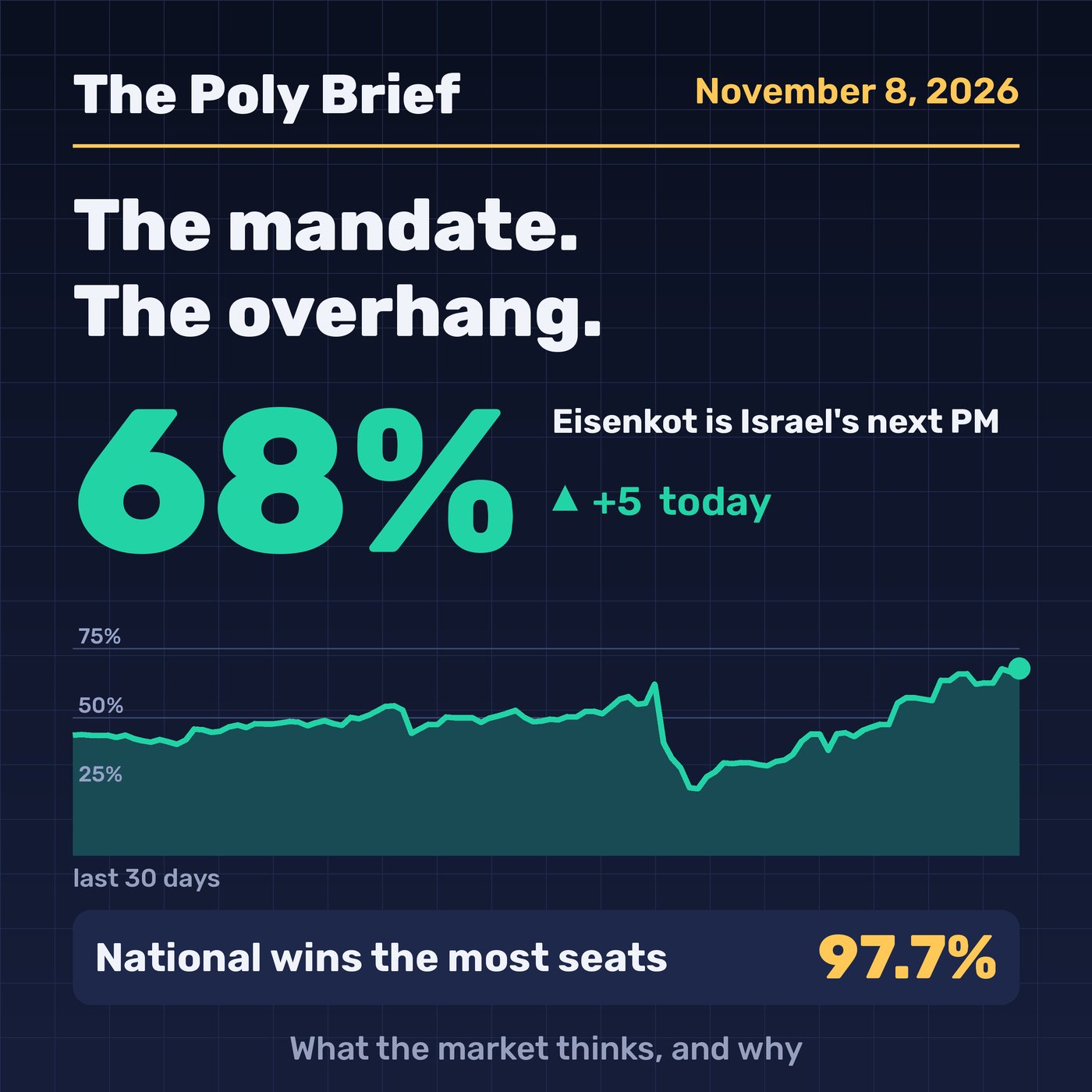
Nov 8: Eisenkot gets the mandate the market said he wouldn't, and New Zealand's fewer-votes favorite
Eleven days ago, Polymarket gave Netanyahu a 67.5% chance to get the first mandate to form Israel's next government. This evening, President Herzog hands it to Gadi Eisenkot, after 67 members of the Knesset recommended him. The market for Israel's next prime minister now has Eisenkot at 68%, a record, and Netanyahu at 18.6. What moved it: Avigdor Lieberman dropping his veto on the Haredi parties. What could still stop it: Lieberman's other veto, and the rule that a caretaker doesn't count.
Then New Zealand. Labour leads the party vote, 29.4% to 29.2%. National has six more seats, thanks to electorate wins, and the market only counts seats: National 97.7% to be the largest party. Plus Who Called It on the US-Iran pause, finally settled after a week of disputes.
Listen to this episode
- Listen onApple Podcasts
- Listen onSpotify
- YouTubesoon
Markets in this episode
Odds at snapshot:
Prime Minister of Israel after the next election?
▲ +5 today+32 7 days
▼ −2 today−19 7 days
24h volume: $964K
New Zealand legislative election winner?
▲ +2 today+27 7 days
▼ −2 today−24 7 days
24h volume: $188K
Who will receive the first mandate to form Israel's next government?
▲ +1 today+30 7 days
▼ −1 today−30 7 days
24h volume: $168K
Transcript
Read the full transcript
Cold open
Maya: On October twenty eighth, the market gave Benjamin Netanyahu a sixty seven and a half percent chance to get the first shot at forming Israel's next government.
Daniel: This evening, at five, President Herzog hands that shot to Gadi Eisenkot.
Maya: This is The Poly Brief. It's Sunday, November eighth. I'm Maya.
Daniel: And I'm Daniel. Every day we take the biggest moves on Polymarket, show you where the odds stand, and ask: why is the market betting this way?
Maya: Today: Israel, and the mandate the market didn't see coming. Then New Zealand, where the party with fewer votes is the ninety eight percent favorite. But first, a bill that finally got paid.
Who called it?
Maya: Who called it? The US and Iran. On November third, after the American strike on an Iranian island, we gave you three dates. The pause holding through October thirty first: seventy seven and a half. Through November second: sixty three point seven. Through November third: six and a half.
Daniel: The October thirty first and November second contracts were disputed again and again. They finally settled on Friday evening, Eastern. Both Yes. And November third was a No.
Maya: So the market was right on all three. Even the one that dropped to twenty seven in the middle of the night.
Daniel: What it tells us: on a market with a clock, the hard part isn't what happened. It's what time it happened. It took a week to agree on that.
Story 1: Israel, the mandate
Maya: Story one. The board. Israel's next prime minister, meaning someone actually sworn in after this election. Gadi Eisenkot: sixty eight percent. A record. Up thirty two points in a week.
Daniel: Benjamin Netanyahu: eighteen and a half. Down nineteen in a week. On October twenty eighth, the morning after the election, we told you Netanyahu forty six and a half.
Maya: And the first mandate market. The one that had Netanyahu at sixty seven and a half?
Daniel: Gadi Eisenkot, ninety nine point six. So, who called it? Not the market. Not eleven days ago.
Maya: So what happened? Netanyahu's bloc has fifty three seats. Eisenkot's has forty eight. How does the smaller bloc get the mandate?
Daniel: Recommendations. On Thursday, sixty seven members of the Knesset told President Herzog they want Gadi Eisenkot. Forty six said Netanyahu. United Torah Judaism, seven seats, recommended no one.
Daniel: The sixty seven include Avigdor Lieberman's party and both Arab parties. That's how forty eight becomes sixty seven.
Maya: And Herzog didn't decide on Thursday.
Daniel: No. He said it's not entirely clear who can form a government, given the mutual vetoes between the blocs and within them. Then on Saturday night, after meeting Gadi Eisenkot and Netanyahu, he announced it. The ceremony is today, at five in the afternoon, Israel time.
Maya: So why sixty eight? What are traders reading?
Daniel: Number one: the veto that moved. Avigdor Lieberman blinked. On Thursday at eight in the evening, Israel time, Channel 12 reported he was dropping his veto on the Haredi parties. In the same two hours, Gadi Eisenkot went from fifty five to sixty two.
Daniel: On Friday, Avigdor Lieberman confirmed it himself: That includes the conscription law. This pains me. And: we must put an end to the Netanyahu era.
Maya: One veto, gone in one sentence.
Daniel: Number two: that opens a path to sixty one without the Arab parties. Gadi Eisenkot's forty eight, plus the Haredi parties. United Torah Judaism already broke with Netanyahu, and its leader Yaakov Asher welcomed Lieberman's move.
Daniel: Number three: the plan B. Gadi Eisenkot is pushing a minority government of the four parties in his bloc, with support from outside.
Maya: The other side.
Daniel: Avigdor Lieberman has another veto. He says he'll vote against any government that depends on the Arab parties. Not just their votes. Even their abstention. And Naftali Bennett says the same: no government that relies on them.
Daniel: So plan B has two members of the same bloc voting against it. And the Haredi parties want a deal on the draft that Gadi Eisenkot hasn't agreed to.
Daniel: And Netanyahu? On Saturday he called for a national unity government. Eisenkot's party called that, quote, a pathetic spin, unless Netanyahu drops the extremists in his bloc.
Maya: And if it all falls apart?
Daniel: Another candidate, then maybe a new election. And Netanyahu stays on as caretaker the whole time. But a caretaker doesn't count for this market. That's part of why Netanyahu is at eighteen and a half, and not forty.
Maya: What to watch. The mandate ceremony, today at five. The new Knesset is sworn in on Tuesday. Gadi Eisenkot has twenty eight days, so roughly until December sixth, plus up to fourteen more.
Maya: Bottom line: the market thinks Gadi Eisenkot gets there. Sixty eight still means about one time in three he doesn't, and the ones who'd stop him are on his own side of the room.
Daniel: And if you like seeing us admit when the market missed, hit follow. We do it a lot.
Bridge
Maya: My building voted on the lobby paint this week.
Daniel: How did that go?
Maya: Beige got more votes. Gray won.
Daniel: How does gray win with fewer votes?
Maya: The top floor gets two votes per apartment. Nobody remembers why.
Daniel: That's not a paint vote, that's an electoral system.
Maya: Funny you say that. Because there's a whole country doing it right now.
Story 2: New Zealand
Maya: Story two. New Zealand voted on Saturday. The board. Which party wins the most seats? National: ninety seven point seven percent. Up twenty seven in a week. Labour: two.
Daniel: And here's the part we love. In the preliminary count, Labour has more votes. Labour, twenty nine point three six percent. National, twenty nine point two one.
Maya: Wait. Fewer votes, and ninety eight percent?
Daniel: Because the market counts seats, not votes. And in seats, National has forty two. Labour, thirty six. According to the Electoral Commission.
Maya: How?
Daniel: New Zealand's system gives every voter two votes. One for a local electorate seat, one for a party. Normally the party vote sets your total. But National won forty two electorates. More than its party vote is worth. And you keep electorate seats no matter what. That's called an overhang.
Daniel: So on these numbers, Parliament has a hundred and thirty one seats instead of a hundred and twenty. And the overhang was not a surprise. A model published by the New Zealand Herald back in October already had National winning more electorates than its party vote.
Maya: And on Polymarket, when did it move?
Daniel: Polls closed at seven in the evening in Wellington. An hour later, National was at fifty seven and a half. Two hours after that, ninety five. As the electorate results came in.
Daniel: Why so low going in? The final polls. 1News had National up by less than a point. Two others had Labour ahead by four to six.
Maya: The other side. Why not a hundred?
Daniel: About four hundred thousand special votes still to count. Roughly fourteen percent of all votes. In twenty twenty three, the specials cost National two seats, and one electorate flipped back to Labour by twenty nine votes.
Daniel: On Saturday night, one electorate had Labour ahead by twenty seven votes at one point. Every electorate National loses is a seat off its total.
Daniel: And if seats ever tie, the market goes to the party vote. Which Labour leads.
Maya: And the government?
Daniel: That's a different question, and this market doesn't ask it. National, ACT and New Zealand First have sixty seven of a hundred and thirty one. Sixty six is a majority. One seat to spare.
Daniel: Prime Minister Christopher Luxon said National has a path to form government, but it's too close to call. Labour's Chris Hipkins didn't concede: New Zealand has spoken. It may take us a little bit longer to figure out exactly what it is that you said.
Maya: And ACT's David Seymour: what's clear is nothing's clear tonight.
Maya: What to watch. The official count started today and takes about three weeks. Official results on Friday, November twenty seventh. We'll be back then, to see who called it.
Maya: Bottom line: Labour may win the vote. National is winning the seats. And the market only reads the seats.
Close
Maya: That's The Poly Brief. Every article and number is linked in the description.
Daniel: And a reminder: these odds are prices, not prophecies. Nothing here is investment advice. Ninety seven point seven still means about one time in forty, it goes the other way.
Maya: If this was useful, follow or subscribe, leave us a rating, and send it to the friend who still thinks the most votes always wins.
Daniel: We're here every morning. See you tomorrow!
Sources
- Polymarket (Gamma API): US-Iran ceasefire continues through...? (resolution status) (2026-11-08)
- Ynetnews: Eisenkot leads Netanyahu 67-46, but Herzog delays mandate decision until Sunday (2026-11-05)
- Israel Hayom: 67 MKs back Eisenkot for prime minister, calls for national emergency government (2026-11-05)
- Brussels Signal: Israeli president holds back mandate despite majority for Eisenkot (2026-11-06)
- Jerusalem Post (citing N12): Liberman drops veto on haredi parties in coalition, opposition in talks with UTJ - report (2026-11-05)
- Ynetnews: Liberman reverses hard line on Haredi draft exemptions to oust Netanyahu (2026-11-06)
- Ynetnews: 'History will not forgive them': Eisenkot presses minority government plan, takes aim at Liberman (2026-11-06)
- To Vima (AFP): Eisenkot Reports Progress As Opposition Courts Ultra-Orthodox (2026-11-06)
- Times of Israel: Herzog announces he will task Eisenkot tomorrow with forming new government after meeting him and Netanyahu (2026-11-07)
- Ynetnews: After meeting Netanyahu, Herzog to task Eisenkot with forming government (2026-11-07)
- Jerusalem Post: Yashar's Eisenkot to receive mandate to form new government, president announces (2026-11-07)
- JNS: Herzog to grant Eisenkot mandate to form Israel's next government (2026-11-08)
- JNS: Israel's 26th Knesset set to be inaugurated Nov. 10 (2026-11-04)
- Ynetnews: Eisenkot bloc moves to take control of Knesset as political deadlock deepens (2026-11-03)
- Electoral Commission (NZ): 2026 General Election preliminary results (2026-11-07)
- interest.co.nz: NZ election 2026 live results, commentary and updates (2026-11-07)
- NewsWire NZ: Luxon says NZ election too close to call as Hipkins refuses to concede (2026-11-08)
- 1News: Final poll: Election set to go down to wire as National's partners slip (2026-11-03)
- The Spinoff: Four final polls, and the tiny margins that could decide the 2026 election (2026-11-06)
- The Spinoff: New polling shows overhang could hand the coalition a second term (2026-10-28)
- The Spinoff: When will we know the NZ election result? (2026-11-06)
- 1News: National needs NZ First to form government, Te Pāti Māori flip more electorates (2023-11-03)